

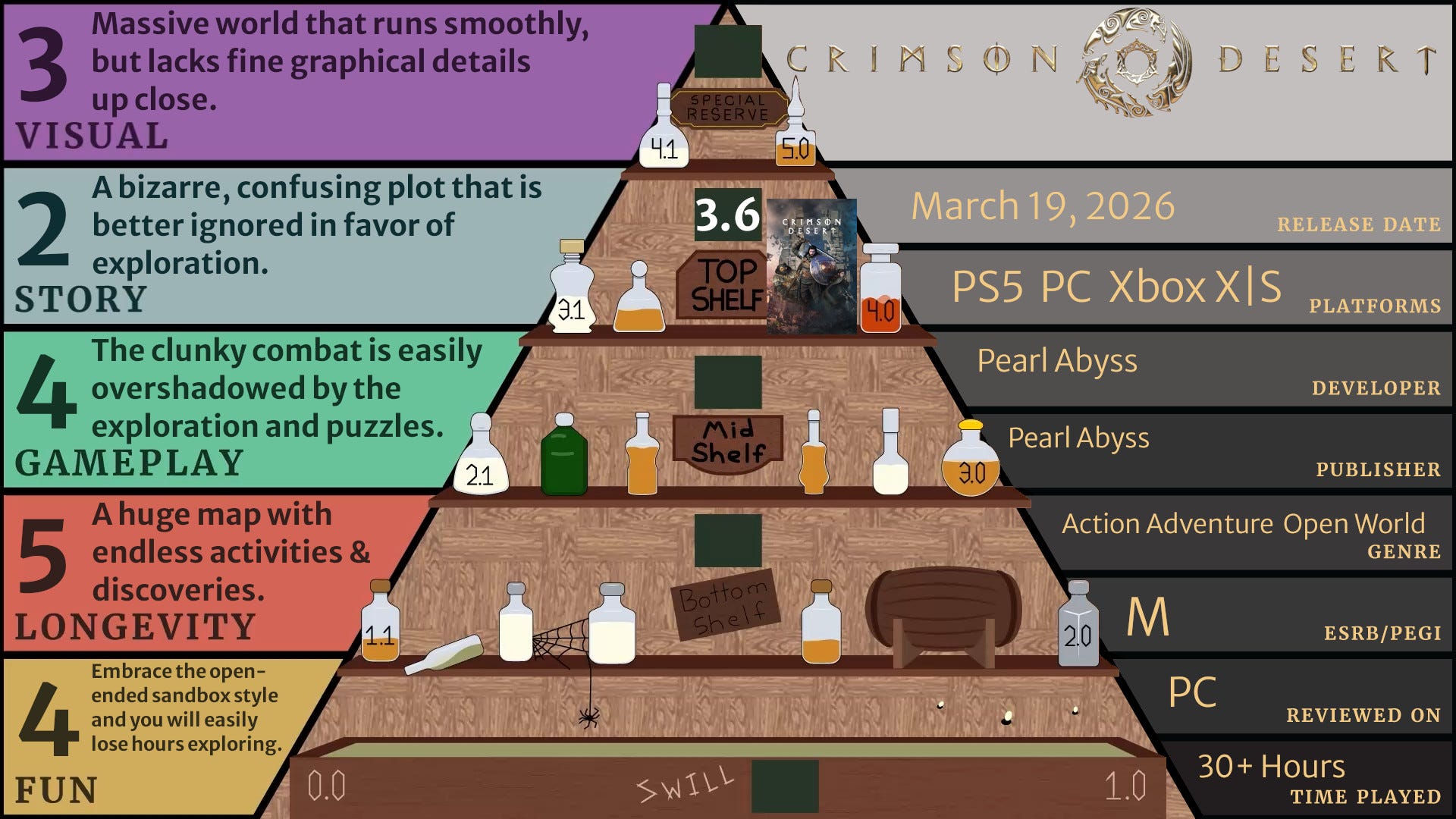
If you jump into Crimson Desert expecting to be blown away by an engaging, story-driven fantasy adventure that guides you through a vast world, you’ll likely be disappointed. I had to learn this firsthand. There is a main story to follow, and it’s smart to stick with it early on since it unlocks many mechanics and tutorials to help you understand the game. However, the story itself is difficult to follow, filled with strange elements like “Gods” guiding you and bizarre situations that the main character just kind of rolls with.
To truly enjoy Crimson Desert, you need to adjust your expectations. Think of it as an action sandbox, and your enjoyment won’t be as limited. You’re dropped into this world to set your own goals. I used to believe a true sandbox required heavy customization, but aside from what you or your mount wear, customization is surprisingly minimal here. Instead, the sandbox aspect comes from simply choosing a direction and exploring what you can discover.
--- A WORLD BUILT ON UNPRECEDENTED SCALE ---
The size of this game is incredible. I’ve played just over 30 hours and still feel like I haven’t uncovered much. You can always skip the confusing main story and explore instead. There are treasures to find, fast travel points to unlock, mounts to tame, and villages filled with bandits to clear out.
The size of the map is hard to fully grasp. I started exploring, and after an hour of walking and climbing, I had only made it maybe a third of the way across the map. It is vast, and the things you stumble upon can be incredibly unexpected. While exploring, I discovered a whole area completely engulfed in a battle between orcs and robots. It was strange and lacked much explanation, but I just had to accept it and enjoy the chaos. Moments like these make creating your own goals so fulfilling.
--- QUANTITY OVER QUALITY: VISUALS AND PERFORMANCE ---
When you have a world this vast, compromises are inevitable, and in Crimson Desert, it’s obvious the developers prioritized quantity over quality. The large world looks stunning from afar, but upon closer inspection of individual objects, that beauty diminishes. Almost everything lacks fine details, and the character models themselves appear rough rather than polished and smooth.
There are some annoying lighting issues. Sometimes areas are too dark when exploring, or the bright sun blinds you for too long after leaving a building. However, this visual inconvenience is actually a blessing in disguise because the game runs smoothly. If there were frame drops, T-poses, or major visual bugs, it would be a terrible experience. But since the performance is steady, I can easily overlook the lack of fine detail and spend hours enjoying the game.
--- UNINTUITIVE COMBAT AND CONTROLS ---
Combat is where Crimson Desert becomes highly divisive. It feels like the developers threw out the established playbook for action game controls and went entirely in their own direction. It’s unintuitive. For instance, heavy and light attacks are mapped to the right trigger and right bumper. Trying to string together combos that involve pressing both buttons simultaneously feels incredibly cumbersome in the middle of a frantic fight.
Then there is the targeting system. There is a “light” targeting system designed to keep you facing enemies, but the combat is loose enough that it’s very easy to start swinging, completely miss your target, and just keep going past them. Worse still, the block button doubles as a temporary lock-on button. Trying to execute a precision parry or block can violently whip your camera around to look somewhere completely different. You can use a hard lock-on, but it doesn’t automatically snap to the next target when an enemy dies, forcing you to manually re-engage every time.
Despite all this, most combat situations don’t end in defeat unless you are utterly overwhelmed by sheer numbers. You are incredibly powerful and possess a lot of AoE attacks that can quickly dispatch groups. The real challenge comes from Boss enemies, who attack fast and hit hard, requiring good timing for parries and dodges. However, once you gain experience and fill out your skill trees, you can almost get through any combat situation by button mashing.
--- A BRILLIANT (BUT FLAWED) CHARACTER SYSTEM ---
One of the neatest mechanics in the game is how you learn new skills. You can actually observe different combat moves in the middle of a fight and learn them on the spot, rather than spending a skill point. But for navigating the world and most combat abilities, you will be allocating earned points.
Crimson Desert features multiple playable characters. They all share loot and experience, with each having their own set of weapons and personal quests. If you get bored with one character’s story, you can easily switch to another. However, there is a big catch: they share a single pool of skill points.
The points put into one character are not available to another unless you manually pull them out. Because of this tedious micromanagement, I haven’t experimented with anybody other than the first playable character, Kliff. Swapping characters becomes a massive chore unless you have put hundreds of hours into the game and have an overflow of points to spare.
--- THE LOOT LOOP: HUNTING, GATHERING, AND UPGRADING ---
If you’re hoping to constantly find exciting new weapons and armor, you need to manage those expectations. Very rarely will a boss drop a new weapon, or a treasure chest yield a new piece of armor. Instead, most of the loot loop focuses on crafting materials. You need wood and ore to upgrade your gear, which means you’ll spend time chopping down trees and mining veins. The world is also full of life—bugs, rabbits, lizards, and buffalo—all of which can be caught or butchered to be used in potions or healing meals.
--- REPETITIVE QUESTS, MINI-GAMES, AND THE DEVELOPER’S DEDICATION ---
The side quests you find in the world don’t offer much variety. Most involve clearing enemy camps or talking to specific people, usually giving you crafting materials or extra bag space as rewards. To break up the pacing, there are many mini-games, like arm wrestling or rock-paper-scissors, which unlock related challenges. Completionists will also stay busy hunting down Sealed Abyss Artifacts linked to the game’s achievement system.
But what really gives me hope for Crimson Desert is the development team. During my first few days, minor annoyances piled up. Bag space was highly limited. Picking up a cooking recipe required me to read it for far too long to learn it, and then the paper would clutter my inventory afterward, forcing me to sell or toss it. Many actions felt downright tedious.
However, players voiced their concerns, and the developers listened. Within a week of release, they released a massive patch that added a storage system, reduced learning times, and included a long list of other fixes. Watching a studio respond and improve their game so quickly completely changes how you see the rough edges. With such dedication to the player base, despite its clunky combat and confusing story, Crimson Desert has a very promising future.