

Title: Cthulhu: The Cosmic Abyss
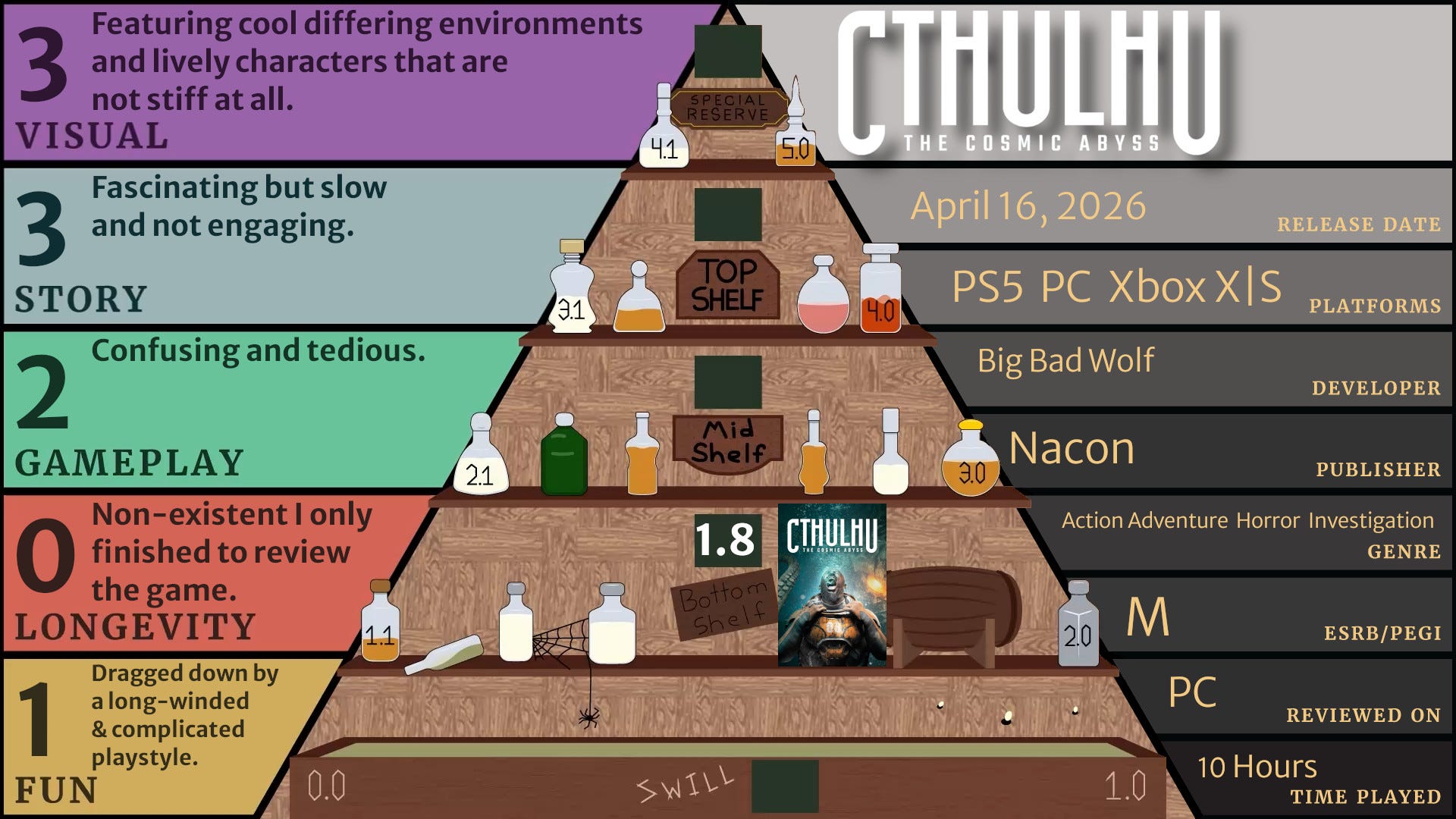
Release: April 16, 2026
Platform: PC PS5 Xbox Series X|S
Developer: Big Bad Wolf
Publisher: Nacon
Genre: Narrative Investigation Action-Adventure Horror
ESRB: Mature 17+
Reviewed on: PC
Time Played: 10 Hours
--- A SLOW SLOG BENEATH THE SURFACE ---
If you jump into Cthulhu: The Cosmic Abyss expecting to be terrified by intense Lovecraftian horror, you will be disappointed. I had to learn this firsthand. I went in wanting a scary, gripping experience. But what I was met with was a slow slog. The game is a first-person Lovecraftian story-driven investigation game, and it completely misses the mark on keeping you engaged. You play as Noah, an agent investigating occult cases alongside his partner Elsa.
The prologue actually sets up a decent mystery. You explore the house of a missing fellow agent named Mei. This quickly spirals out of control when you discover a portal to another dimension. You find Mei, but she has completely lost her mind and attempts to kill you both. Noah barely escapes, but Elsa is left behind in the abyss. It sounds like a great hook. But then the game jumps forward eight months, and everything grinds to an agonizing halt.
Noah tracks a lead to an underwater drilling facility that supposedly went dormant. Here, you find evidence of the previous crew exploring the supernatural and tracking their descent into madness as they attempted to awaken the ancient one. It sounds fascinating on paper. However, the plot is extremely heavy and ultimately boring. It is a slow-paced game focused entirely on investigations, finding clues, and solving puzzles. There is absolutely no combat to break up the pacing. The story definitively concludes, but it ultimately feels like a bust. The pacing is agonizingly slow, and the heavy mature themes just bog down the experience instead of elevating the tension.
--- THE VAULT OF TEDIOUS DEDUCTIONS ---
The core gameplay loop centers around a mechanic called The Vault. This is a special space inside Noah’s AI companion, Key. All discovered clues go here. You are supposed to move them around, connect them with drawn lines, and deduce answers to move forward. But the initial tutorial completely fails to explain how this actually works. It left me confused for the first few hours of the game. The tutorial explained I could deduce clues together by merging them in a way. The way it was brought up I thought it would be more obvious to me when I could merge clues, almost like a mini-game.
However, the deduction connection was much more manual. The questions that needed to be deduced would appear as a purple clue with a line to an empty space. I was supposed to place the relevant clue in that space to deduce the answer for the question being asked. This game requires copious amounts of reading to properly get through. Chapters are flooded with clues like notes from old expeditions, tablets, and random items. Far too many clues were fluff that could be ignored, but you wouldn’t know it until you read it all.
For want-to-be detectives, this would be a great game. But for me, it was tedious and boring. Some deductions made sense to me, and it felt nice to figure them out. But a lot of them I would brute force my way through, testing all of the relevant clues in the empty space until one answered the question, moving the game forward. It worked, but it was not enjoyable.
--- A CLEVER SONAR SYSTEM BURIED IN CLUNK ---
The one saving grace of the gameplay is the Sonar system. It was a highly enjoyable mechanic that actually made me feel smart. Upon discovering an object, you deduce its material makeup, then tune your sonar to scan the environment for matching materials to find new clues. At first I thought I could scan for up to three things at once. But then nothing was showing up when I scanned, even though I knew the material I was scanning for was right in front of me. It wasn’t until later I realized I was scanning for things with that particular makeup.
For instance, there was a flooded room that the system couldn’t pump out due to clogged pipes. I could scan the pipe material, which was titanium, and follow the lines, but I could never see anything wrong. It wasn’t until I found an old pipe with some otherworldly mushroom clogging it up that someone had tried to clean that I realized the solution. I needed to scan for titanium and the otherworldly mushroom together to identify the clogged pipes I needed to replace. Figuring that out felt genuinely rewarding.
While the sonar itself is free to use, analyzing the clues you find costs energy, and managing that energy introduces a whole new set of problems. Energy lycium is sparsely found throughout the facility. To recover energy, you have to find special mushrooms, absorb them into a vial, and inject them directly into Noah’s forearm. I didn’t have a problem shooting up the mushrooms, as that was a necessary act for energy. But when I didn’t have any energy, I opted out of analyzing clues. However, some had to be analyzed to move forward, so I took a corruption hit a couple of times.
Corruption is a slow spreading affliction that destroys the evolutions you equip to Key. These evolutions act as mods for your AI companion that grant helpful buffs, like expanding your sonar range or refunding spent energy. When corruption takes over, you lose those benefits entirely. There was a warning at the start of the game explaining corruption is always present and growing, and it dictates the choices available at the end of the game. I did end up using the game settings to mitigate some of this. I asked Key for hints on specific clues. I could ask for three hints per important clue, each hint giving more information until the final one told me exactly what I needed to do. Most of the time that was very helpful to move forward, though sometimes it did create a lot more questions and problems for me.
--- THE MISERY OF CHAPTER FIVE ---
Then there is Chapter 5. I absolutely hated Chapter 5. It features an incredibly punishing section that completely abandons the slow investigation for a frustrating trial-and-error loop. It wasn’t a chase sequence, just slow exploration. There was a milky substance produced by an unknown entity that I had to walk over to cross chasms. This material would only show right in front of my feet as I moved. I could only move a couple inches at a time to make sure I was still on the right path, making progression very slow.
To make matters worse, there was a worm monster that would start to stalk me while on these invisible bridges. If I lingered too long, a chest-bursting worm would rip through me, causing me to start over right before the bridges. It was a frustrating setup that killed me a lot. I would find a solid spot and start jumping across hoping to find another solid spot and get through that section before the worm got me. I fell a lot during this trial and error, and the worm got me a couple times as well. There may have been a way to see the bridges with the sonar, but I never figured it out. It was a miserable experience.
--- ATMOSPHERIC VISUALS AND EMPTY SOUNDSCAPES ---
Visually, the game does have some merits to appreciate. The graphics aren’t terrible, and the different sections of the underwater facility feel visually unique. The atmosphere gets notably darker and more pressing the deeper you progress into the game. The character models are also surprisingly good. The facial expressions are impressive. While they are not hyper-realistic, the characters feel alive and expressive, and they are not stiff at all.
Sadly, the audio design completely drops the ball. It is very forgettable. Music is only present occasionally. The soundscape mostly consists of the repetitive thump thump thump of the protagonist’s boots walking around the empty metal hallways. This lack of sound design severely hurts the tension.
--- A LACKLUSTER RUNTIME ---
As for the length, my first playthrough took around nine hours to beat. But honestly, the only reason I finished was to review it. I would have quit in the first few hours otherwise. It is long-winded and too complicated. If you know the puzzle solutions and which clues to ignore, a second playthrough could be blitzed in about four to five hours. But the replayability is incredibly low. It is doubtful you would ever want to play it again once you roll the credits.
--- CAN THE KIDS WATCH? ---
Parents should know that this game contains extremely heavy and mature themes that are likely too boring or complex for children to understand or enjoy watching. There is a general presence of blood and violence throughout the adventure. In the prologue, a former ally loses her mind and attempts to murder the protagonist and his partner. There is also a severe, on-screen instance of a character taking their own life. You will hear quite a few curse words while exploring. Finally, there is a recurring disturbing action where the main character must extract mushroom essence into a vial and inject it directly into his forearm to regain energy. There are no jumpscares, but the game discusses ritual sacrifice and self-harm.
--- CONCLUSION ---
Cthulhu: The Cosmic Abyss is a game that demands an incredible amount of patience for very little payoff. Ultimately, this game demands focus that feels unrewarded. The premise of an occult underwater investigation is fantastic, and the sonar mechanics provide brief moments of genuine satisfaction. But the tedious clue management, the confusing menus, and the absolute misery of the invisible bridges overshadow the few bright spots. It is a slow, frustrating descent into madness, but sadly, not the fun kind.