

Title: Narin: The Orange Room
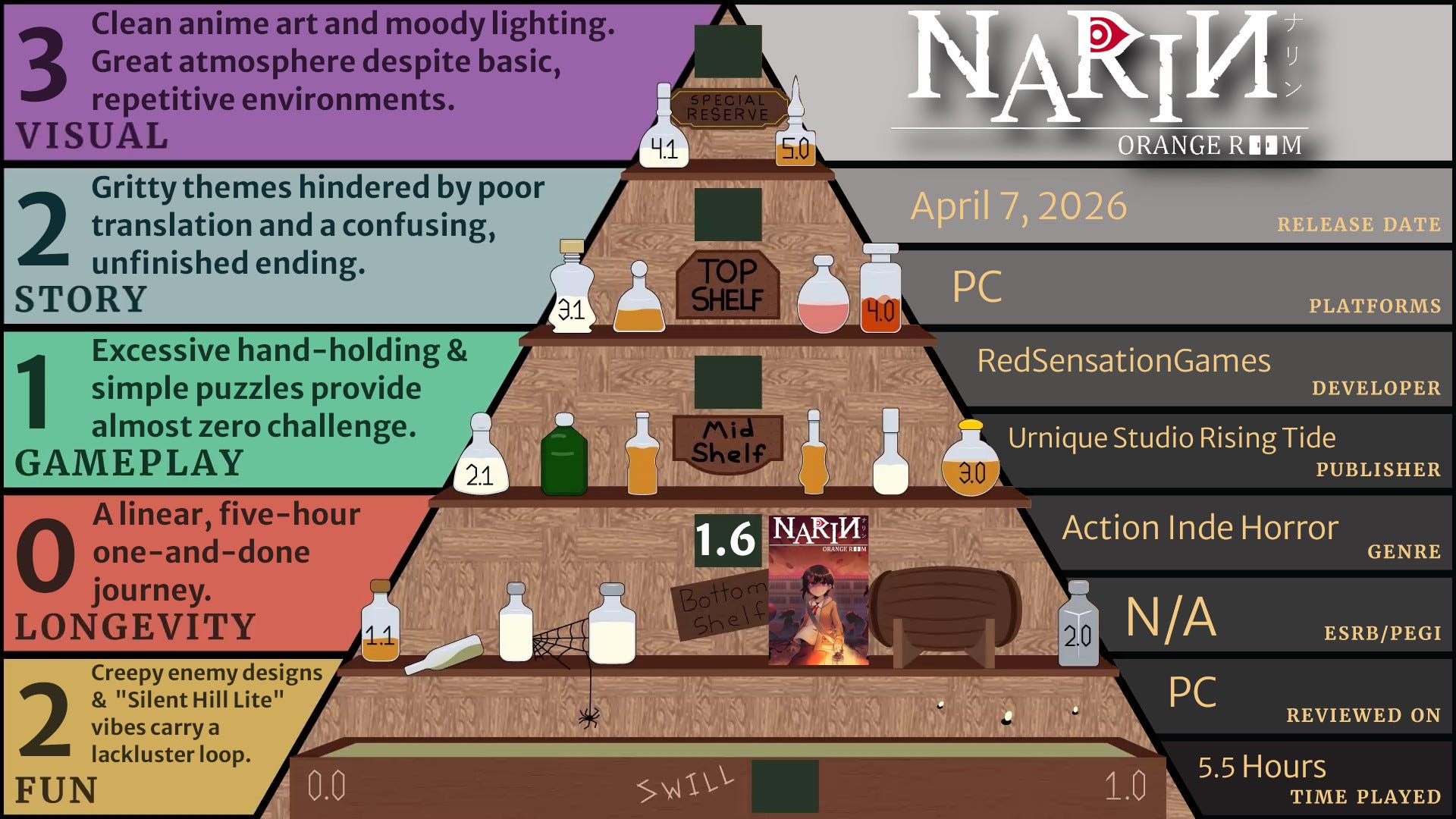
Release: April 7, 2026
Platform: PC
Developer: RedSensationGames
Publisher: Urnique Studio Rising Tide
Genre: Adventure Indie Horror
ESRB: N/A
Reviewed on: PC
Time Played: 6 Hours
Narin: The Orange Room initially presents itself as a lighthearted indie adventure. You play as Narin, a young girl searching for her missing sister within her school. The first hour suggests a game aimed at a younger audience, featuring a friendly talking cat and puzzles that require very little mental heavy lifting. It establishes a familiar loop of exploration and basic interaction that feels safe and almost whimsical. This initial impression is deceptive, as the game eventually trades this safety for something much more unsettling.
This innocent facade begins to crack as you delve deeper into the story. What starts as a simple search through a school building evolves into a much more intense and mature experience. The game shifts its tone significantly, introducing imagery and themes that stand in stark contrast to the bright anime art style and the early introduction of a feline companion. This transition defines the core experience, moving from a standard mystery into something that feels like a simplified version of classic psychological horror. It uses the school setting to ground the player before pulling the rug out from under them with increasingly dark story beats.
The game is a relatively short experience, clocking in at roughly five and a half hours from start to finish. During this time, the gameplay remains consistently linear, guiding you through a series of specific encounters and environments. While the initial learning curve is almost nonexistent due to the simplicity of the early tasks, the shifting atmosphere provides the primary motivation to see the journey through to its end. The pacing is quick enough that you never feel bogged down, but the mechanics’ lack of complexity means the heavy lifting is done almost entirely by the atmosphere and the unfolding mystery.
--- THE STRUCTURE OF THE TWILIGHT DIMENSION ---
The gameplay is structured over multiple days, with each new day shifting the focus to a different part of the school and introducing fresh obstacles. This format lets the game gradually build tension without overwhelming the player early on. In the beginning, the Twilight Dimension feels like a haunted space filled with vague, ghostly shapes that you simply need to avoid by keeping your distance. These early segments are more about atmosphere and learning the layout than about high-stakes survival. The ghosts serve as a baseline threat, teaching you to respect enemy sight lines.
As the days progress, the nature of the threats shifts from amorphous ghosts to more distinct, predatory figures. These primary antagonists are tethered to specific sections of the school, serving as the main obstacle for that portion of the journey. These stalkers have unique visual profiles and behaviors that demand a more careful approach to navigation. By rotating these encounters, the game keeps exploration from feeling too repetitive, even if the core mechanics of sneaking remain the same. The shift from generic ghosts to specific, identifiable threats marks the point where the game starts to feel like a more serious horror title.
The transition between these days also marks a shift in how you interact with the environment. Early on, the school is relatively open, but as the danger escalates, you are forced into tighter corridors and more claustrophobic spaces. This progression mirrors the story’s descent from a simple missing-person search to something far more psychological. The game signals when a new threat is active, ensuring you never feel completely blindsided by a change in enemy behavior. It creates a rhythm of exploration followed by high-tension evasion that carries the experience through its short runtime.
--- STEALTH AND NAVIGATION MECHANICS ---
The stealth system in Narin: The Orange Room is functional but lacks depth. Most encounters are resolved by staying crouched and maintaining a physical barrier between yourself and the enemy. If an enemy is not facing you, you can walk normally, but running is almost always a mistake because of the noise it generates. There was one instance where I was caught while hiding under a desk, suggesting that the line-of-sight mechanics can be a bit unpredictable. However, for most of the game, the stealth feels like a secondary layer to exploration rather than a complex system to master.
The consequences of being caught are relatively light. If an enemy grabs you, it results in an immediate game over, but the checkpoint system is very forgiving. You are usually placed right outside the room where you were caught, allowing you to jump right back into the action without losing much progress. This reduces much of the potential frustration, but it also lowers the overall tension. You never truly fear the enemies because you know a mistake only costs a few seconds. This makes the horror feel more like a series of puzzles to solve rather than a life-or-death struggle.
Navigation is handled without a map, which might sound daunting in a school setting, but the game is designed to keep you from getting lost. The areas are relatively small, and the path forward is usually quite obvious. Narin herself provides constant narration that tells you exactly where to go and what needs to be done. While this makes the game accessible, it also removes any sense of discovery or player agency. I only found myself turned around once during the entire five-hour run, and it took very little effort to find the correct path again. The school layout is logical, and the game rarely forces you into complex backtracking.
--- THE VITAL ROLE OF THE LAMP ---
Your primary tool for navigating the darkness is a lamp. It helps you see in the darker corners of the Twilight Dimension and clear specific obstacles like smoke or roots. It is a vital mechanical tool, but it does not require resource management. There are no batteries to find or oil levels to monitor. You simply turn it on when needed and use it to progress along the linear path the developers have laid out. This simplifies the experience and keeps the focus on the story rather than the logistics of survival.
The lamp serves as both a literal light in the dark and a means of interacting with the environment. In certain sections, the darkness is so thick that you cannot see more than a few feet ahead without it. While this adds to the atmosphere, the lack of a resource limit means you never have to make tough choices about when to use your light. It functions more like a key for specific doors than a survival tool. Narin will often remind you to use the lamp even when the solution is obvious, reinforcing the feeling that the game is guiding you along a preset path.
Despite its simplicity, the lamp provides some of the game’s most striking visual moments. Seeing the light cut through the oppressive shadows of the Twilight Dimension creates a strong sense of atmosphere. It highlights the details of the twisted school architecture and makes the transition into darker areas feel more impactful. It is a constant presence, and while it doesn’t add much challenge, it is an essential part of the game’s identity as a school horror title. The interplay between the small circle of light and the surrounding darkness is where the game is most effective at building dread.
--- PUZZLES AND ENVIRONMENTAL INTERACTION ---
The puzzles in this game are generally very easy to solve. Most involve finding a key item or a code to unlock a lock, with the solution usually nearby. The game does a lot of the work for you, often repeating directions or reminders about how to use a tool. Narin frequently comments on how she can use her lamp to clear an obstacle, even after you have already done it several times. This hand-holding persists throughout the entire experience, which can be frustrating if you are looking for a challenge. It feels like the developers were afraid the player might get stuck for even a moment.
There are a few brighter spots where the puzzles require a bit more engagement. These involve reading notes left in the environment and exploring a specific room to piece together clues. These moments were a welcome change of pace from the standard fetch tasks that make up the rest of the game. Unfortunately, these more complex riddles are the exception rather than the rule. Everything you need to solve a puzzle is readily available, and there was never a point when I felt the need to take notes or think critically about the environment. The lack of complexity makes the gameplay feel like a vehicle for the plot.
The school itself serves more as a backdrop for the story than as a place full of lore to discover. While there is a section where the environment shifts to resemble a much older school, the game never explicitly explains why this change occurs. This lack of detail forces the player to make assumptions about the history of the Twilight Dimension. The school layout is easy to learn, but it lacks the fine details that would make it feel like a lived-in space with its own history. It is a series of rooms to be cleared rather than a cohesive world to be explored.
--- VISUALS AND THE ATMOSPHERIC SHIFT ---
Visually, the game uses an anime-inspired art style for both the characters and the environments. The character portraits that appear during dialogue are well-drawn and help convey the cast’s emotions. The 3D environments are simple but effective at creating an oppressive atmosphere once you enter the Twilight Dimension. The transition from the normal school to the twisted version is handled primarily through lighting changes, forcing you to rely on your lamp to see into the corners of the rooms. The contrast between the bright, clean school at the start and the decayed version in the Twilight Dimension is stark.
The most striking aspect of the visuals is the shift toward more mature, graphic imagery as the story progresses. While the early hours are clean and safe, the later stages of the game introduce disturbing still frames that depict heavy themes. These images are quite graphic and feel like they belong in a much darker game than the intro suggests. This shift creates a sense of dread that is more effective than the scattered jump scares found throughout the school. The jump scares themselves are often cheap and ineffective, but the static imagery used during major plot points carries a lot of weight.
The enemies you encounter share this design philosophy. The ghosts are simple black shapes, while the more distinct stalkers have unsettling features that make them stand out. The Janitor is a standout design, featuring a large human frame with multiple eyes plastered across its head. It is creepy and unsettling without being overly grotesque. Similarly, the Scissors Girl uses her four arms and high-pitched screeching to create a memorable presence. Their designs are effective because they fit the anime aesthetic while still feeling off-putting in the game’s lighting.
--- AUDIO AND VOICE ACTING ---
The audio design is minimalist, which helps build a sense of isolation. Most of your time is spent in silence, punctuated only by the sounds of your own footsteps or the distinct noises made by the enemies. This silence makes the sudden screech of a monster or the heavy thumping of the Janitor’s footsteps feel even more impactful. However, the voice acting is a much more inconsistent element of the presentation. The game features English voice acting for Narin, the only voiced character, but the performance is severely lacking.
The English voice lines are delivered with very little emotion or life, making it hard to care about Narin’s plight. I found the performance so distracting that I eventually turned it off. I tried the Thai voice track for a moment, and even though I didn’t understand the language, the delivery felt much more authentic. The Thai voice actress conveyed the fear and desperation that Narin was supposed to feel. It added a level of depth to the character that was completely missing from the English version. Hearing the emotion in her voice made the more intense scenes feel more grounded.
The game’s origins as a Thai indie project are very apparent throughout the experience. As someone who is not Thai, I felt that a significant amount of the cultural context or specific storytelling nuances might have been lost in translation. This likely accounts for the odd phrasing and the sense that some plot points lacked their intended weight. It creates a barrier that made it difficult for me to connect with the core emotions being portrayed. Between the lackluster English acting and these translation quirks, the gap between the developers’ intent and the final English product is noticeable.
--- THE ROLE OF COMPANIONS AND NPCS ---
The Black Cat that accompanies Narin is almost entirely a plot device. While it follows you on screen and occasionally guides you toward an objective, it plays no active role in gameplay. You cannot control it, and it does not help you solve puzzles or avoid enemies in any meaningful way. Its primary purpose is to provide exposition and explain the mechanics of the Twilight Dimension to Narin. It serves as a bridge between the player and the world, but it feels like a missed opportunity for more engaging gameplay interactions. The cat acts more like a moving waypoint than a companion.
You also encounter other children who have found their way into the Twilight Dimension. These characters do not offer side quests or much in the way of interactive gameplay. Instead, they are placed in the world to move the story forward and raise more questions for the player to ponder. They appear mostly in the visual novel segments, providing context for the missing students and the general danger of the school. Like the cat, they are tools for the story rather than actors in the world. Their presence helps flesh out the situation, but they feel very static within the 3D environment.
The visual novel aspects of the game take up a significant portion of the runtime. When major story points occur, the game often switches to still frames with text describing the scenes and interactions. This storytelling style is effective for an indie budget, but it can feel a bit disjointed when paired with the 3D exploration. These segments are where the character-driven writing is most prominent, focusing on the emotional weight of Narin’s search for her sister.
--- A LACK OF SATISFYING RESOLUTION ---
As the story reaches its conclusion, it takes several turns that raise more questions than they answer. The plot eventually piqued my interest after a slow start, but the final moments were deeply unsatisfying. The game essentially stops, leaving many of the core mysteries of the school and the Twilight Dimension entirely unresolved. It feels as though the developers simply ran out of room to explain the internal logic of the world they created. Rather than a cohesive finale, the experience just ends with a heavy sense of confusion.
The title itself, The Orange Room, remains a bit of a mystery by the time the credits roll. The name’s significance may be tied to a cultural reference or a translation detail that does not translate well for an international audience. Regardless of the reason, the lack of a clear explanation for the game’s namesake adds to the general sense of frustration at the end of the journey. The story focuses heavily on emotional themes, but it fails to provide the concrete answers needed to make the mystery feel worthwhile. You are left trying to connect dots the game never actually draws.
This lack of resolution is the game’s biggest hurdle. You spend five hours navigating a creepy school and confronting intense imagery, only to be met with a conclusion that feels entirely unfinished. It creates a sense of disappointment that overshadows the game’s interesting world-building and the Silent Hill Lite atmosphere it works so hard to establish. While the journey has its moments of tension and emotional impact, the destination leaves much to be desired because it fails to tie its many threads together in a meaningful way.
--- FINAL VERDICT ON THE ORANGE ROOM ---
Narin: The Orange Room is a game of sharp contrasts. It transitions from a safe, almost juvenile adventure to a heavy, mature horror experience with surprising effectiveness. The multi-day structure provides a clear progression of enemy types, and the atmosphere of the Twilight Dimension remains consistently eerie. However, the game is held back by overly simplistic puzzles and a constant stream of hand-holding that keeps the player from ever feeling truly challenged or clever.
The technical performance is solid, with very few bugs or issues during the playthrough. While the English voice acting and translation are weak points, they are balanced by the strong anime art style and the unsettling design of the main antagonists. The game succeeds as a Silent Hill Lite experience for those who want an emotional, atmospheric horror story without complex combat. It captures a distinctive school-horror vibe, even if the writing stumbles in the final act.
Ultimately, whether you enjoy this game depends on your tolerance for a linear, guided experience and a story that leaves you with a significant sense of disappointment. It is a competent indie effort that showcases some great atmospheric ideas, but it falls short of delivering a cohesive, clear finale. If you are looking for a short, creepy journey through a haunted school and don’t mind a lack of closure, Narin: The Orange Room is worth a look, but it leaves far too many questions on the table.