

Title: Pragmata
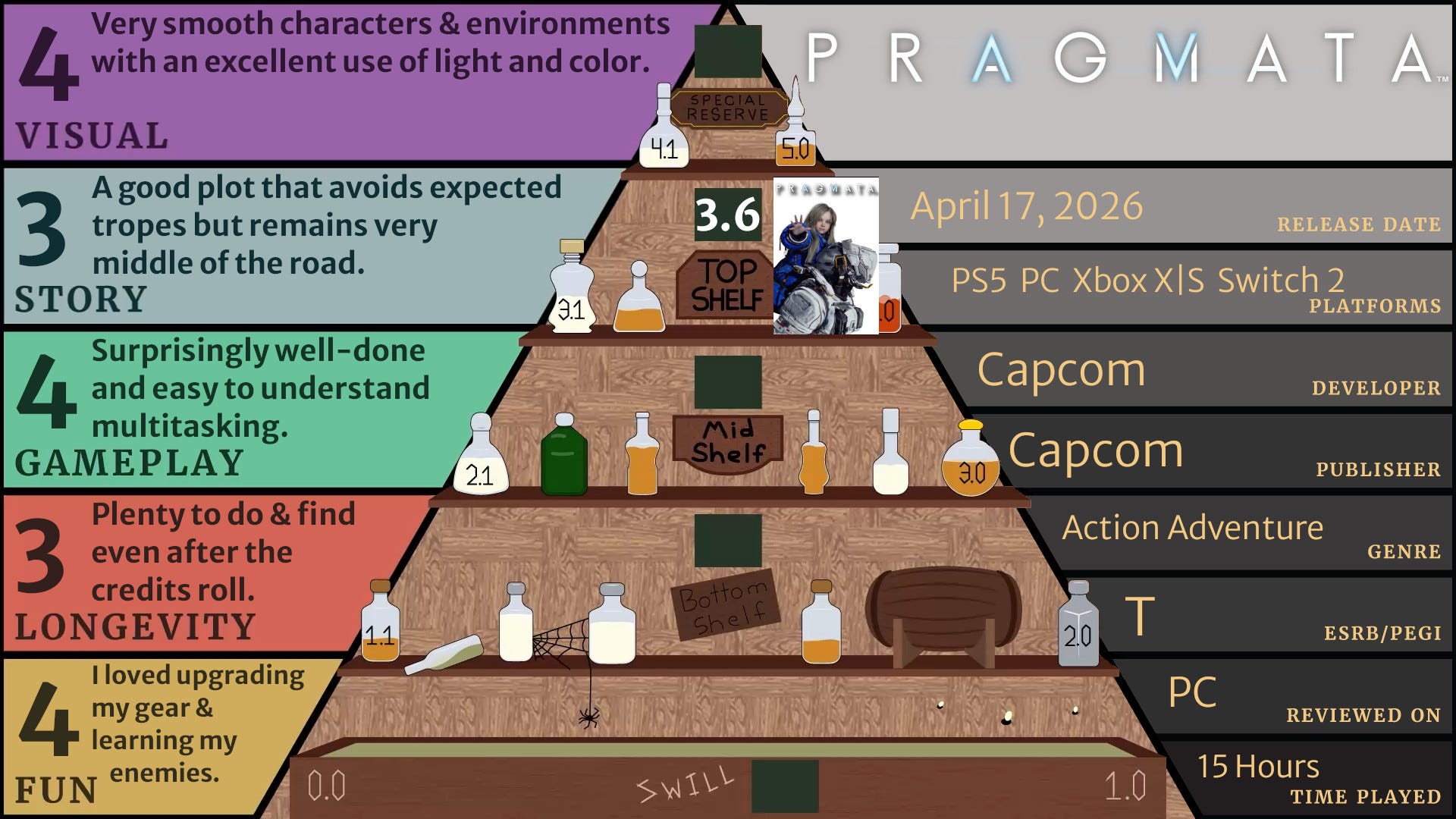
Release: April 17, 2026
Platform: PC PS5 Xbox Series X|S Nintendo Switch 2
Developer: Capcom
Publisher: Capcom
Genre: Action-adventure
ESRB: T
Reviewed on: PC
Time Played: 15 Hours
--- A JUGGLING ACT OF COMBAT AND HACKING ---
Combat is where Pragmata truly carves out its own distinct identity. It throws a lot at you all at once. Nearly every fight felt the exact same, save for some unique boss encounters and the minor differences of enemies requiring different fighting tactics. But that loop is surprisingly well done. A fight starts with a bot appearing and moving closer, ready to attack. Initially, these robots are closed up tight, and Hugh’s bullets do minimal damage against their armor. In order to actually do decent damage, Diana must open the bots by hacking them. Once they are exposed, Hugh can shred their health, and Diana can continue hacking to cause even more damage with each successful breach.
Here is how that actually plays out in your hands. When Hugh aims his gun at an enemy, the hacking grid immediately appears on screen. Inside is a node I can move around using the face buttons of the controller, in my case XYBA. The ultimate goal is to hit the green node within the grid. But getting there is a high-speed puzzle. I can pass through blue power nodes that increase the damage of the hack, or hit yellow nodes appearing from special hacks I keep in my inventory, causing confusion or other status effects on a successful breach. And there are sometimes red nodes that will cause the hack to fail entirely, forcing me to start over.
While I am solving this grid on the right side of the controller, I can use all the other buttons to move Hugh and shoot at the exact same time. It demands easy multitasking. If the enemy gets dangerously close, I can simply stop aiming and get away quickly. This forces the grid to close. However, if I didn’t take any damage during my escape, I can pick up right where I left off the next time I aim.
This intuitive multitasking makes the combat flow beautifully. Despite looking insanely complex, it felt natural and simple to execute. It falls just short of becoming too repetitive because the grid puzzles evolve, growing from simple three-by-three squares to massive ten-by-ten labyrinths. You have to train your brain to split its focus. Sliding that node around the grid while a massive robotic monstrosity bears down on you creates incredible tension. Deciding whether to risk hitting a blue power node for extra damage or taking the safe route to the green node is a constant split-second gamble. Hitting a yellow node and watching the enemy bot get confused and stagger gives you a massive adrenaline rush.
--- EXPLORING THE LUNAR SURFACE —
When you aren’t fighting for your life, the exploration takes over. The visual quality of the graphics is high. The lunar surface is highly detailed and incredibly enjoyable to explore. They made excellent use of light and color, and the character models look very smooth. The UI is also very clean. It effectively shows necessary info like your health and the hacking grids while leaving plenty of screen real estate to watch for incoming dangers.
Pragmata also sprinkles in some heavy Metroidvania elements. It wasn’t necessary to backtrack if you wanted to just beat the game. You can push straight through the story in about ten hours. But backtracking rewarded a plethora of tokens and upgrade materials. I didn’t start backtracking until nearly the end of the game. When I finally did, I found out I could actually find upgrades to Hugh’s healing containers, allowing me to carry more before running out.
Exploration is directly tied to your power increases. Upgrading your gear makes a tangible difference in your combat viability. It significantly reduces the tedium of fighting the tougher MK II versions of the robots. I loved learning my enemies so I could dispatch them quickly. The difficulty scaling is perfectly tuned. I died a couple times, but rarely to repeat enemies. It was always just challenging enough to keep moving forward, and never was I held back for long during difficult sections.
And this game respects your time. A semi-completionist run will take you approximately fifteen hours. That breaks down to about ten hours for the main plot and five hours dedicated to backtracking for upgrades. But the longevity stretches far beyond the credits rolling. There is plenty to do and find even after the main campaign ends. If you want to see everything and complete the game one hundred percent, you could easily get twenty plus hours out of this experience. The post-game content unlocks a brand new difficulty setting, dropping extra content including new outfits and highly unique weapons and mods. These late-game additions actually introduce brand new playstyles, giving you a great reason to jump back in and test your mastery of the dual-control combat.
--- BINGO, MEMORIES, AND THE SHELTER ---
To break up the flashy violence of the combat loop, you spend a lot of downtime in The Shelter. This is your main hub. It features the training facility and your suit upgrades, but the social systems are what truly make it special. When back in the Shelter, I could gift Diana Real Earth Memories, or R.E.M.s for short. Once gifted, these items would be printed into a special area of the shelter for Diana to play with or observe.
After handing over so many R.E.M.s, Diana would reward me with hand-drawn pictures. They provide a charming contrast to the cold sci-fi setting. They are very cute and totally fridge-worthy, obviously drawn by a young child. They are amazing, that is, if you can get past the idea that they are pictures created by an AI. It is a funny bit of irony in a game centered around artificial intelligence going rogue.
The rewards don’t stop at crayon drawings. For every R.E.M. you gift, you receive one cabin coin. These coins are used for the bingo game run by Cabin, a helpful robot who takes care of the Shelter. The bingo cards gave small rewards for every uncovered square and even greater gifts for multiple bingos or a whole blackout. These gifts were incredibly useful. You unlock special notes about the old employees of the Cradle, lore about the different robot enemies, mods, guns, new hacks, and different outfits for Hugh and Diana.
--- CAN THE KIDS WATCH? ---
This is a pretty safe one to watch with the kids if the gun fights are alright. The language is clean and you won’t find any profanity in the character dialogue or the radio transmissions. There is absolutely no blood, no dismemberment, and no scary scenes or organic monsters jumping out from the dark. The action strictly features copious amounts of flashy violence toward robots using various firearms. The core themes focus heavily on survival, isolation, and a highly positive, protective bond between an adult and a child-like companion.
--- A LUNAR SUCCESS ---
Pragmata is a massive surprise. It takes a bunch of distinct ideas and smashes them together into something that feels entirely fresh. The combat could have easily devolved into a frustrating mess. Instead, it offers a deeply satisfying rhythm that rewards quick thinking and steady hands. The world is beautiful to look at, and the loop of fighting, exploring, and returning to The Shelter to play bingo keeps you hooked for hours.