

Title: Project Songbird
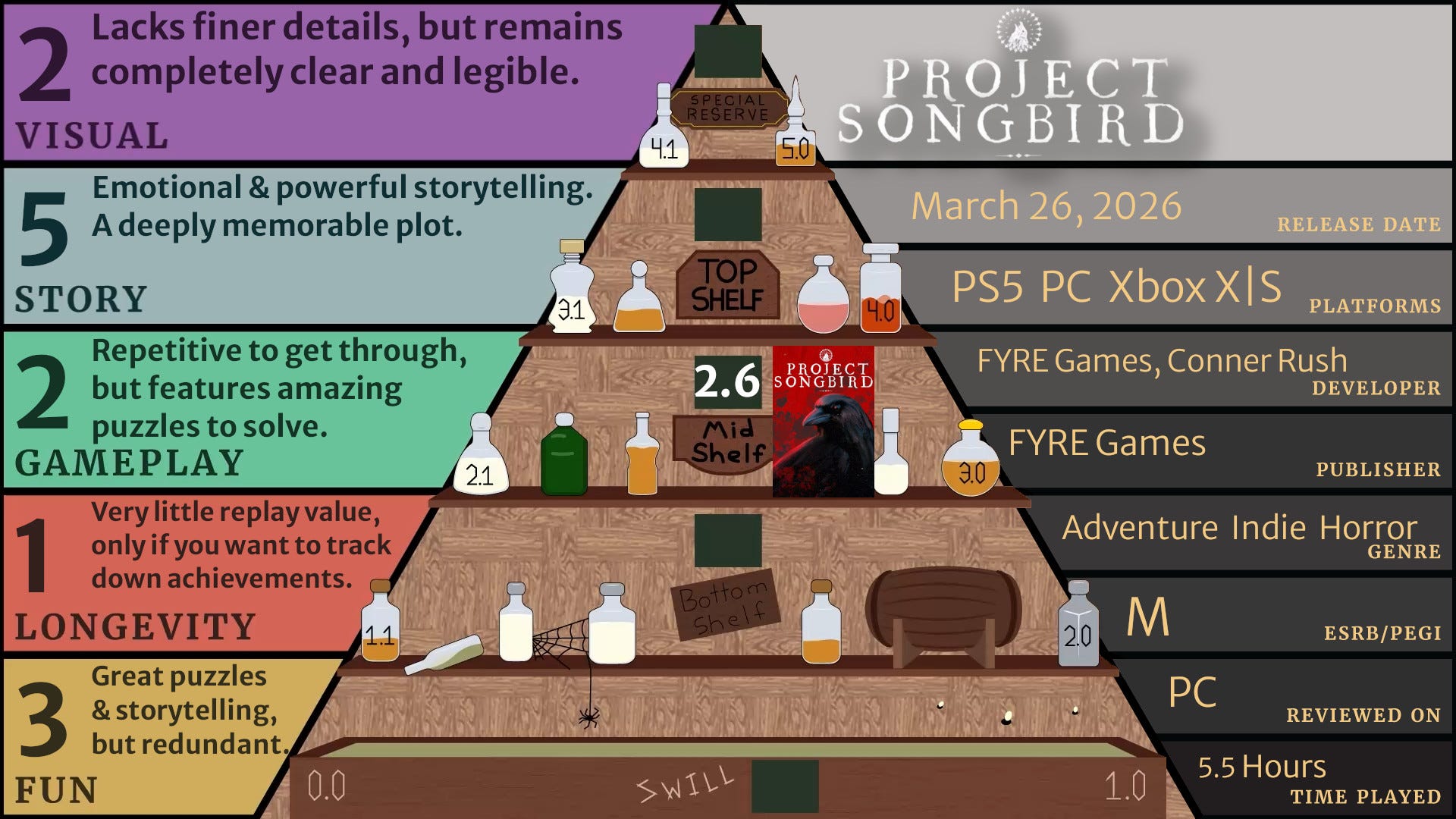
Release: March 26, 2026
Platform: PS5 PC Xbox X|S
Developer: FYRE Games, Conner Rush
Publisher: FYRE Games
Genre: Adventure Indie
ESRB: M
Reviewed on: PC
Time Played: 6 Hours
Project Songbird is a psychological horror indie game that puts you in the shoes of Dakota, an established musician struggling to find her motivation. Following a tragic event, she loses the drive to create the music her fanbase expects. Her manager convinces her to pack up her gear and head to a remote cabin in the woods to find inspiration. The game immediately sets a heavy tone. You spend the initial stages learning the basic controls while Dakota tries to record the sounds of nature for her new demo, a small mechanic that includes a dedicated achievement.
The atmosphere of the game quickly shifts from a peaceful retreat to a deeply disturbing experience. Dakota is constantly haunted by the image of a large red door in her mind. This visual obsession spills into the dark woods surrounding the cabin, transforming a simple trip for inspiration into a terrifying ordeal. The learning curve emphasizes familiarizing yourself with basic survival tools and sneaking past threats instead of engaging in intense combat or complicated action scenes.
During a five-and-a-half-hour playthrough, the game reveals itself as a powerful story about the creative process. It emphasizes the immense pressure artists face from managers and audiences alike. The main conflict centers on the struggle between making popular art that earns money and creating what the artist truly wants to produce, even if it attracts negativity from others.
--- VISUALS AND WORLD EXPLORATION ---
The graphics in Project Songbird are quite similar to those in the crowded indie horror market. While the design isn’t top-tier, the visuals are clear and fully legible. You won’t struggle to decipher grainy textures or poorly rendered objects. The game features a small, linear world with simple environments. Since the game is relatively short, it offers only a few distinct locations to explore. Your time will be spent walking down forest paths, exploring a church, investigating an old mine, and navigating a few areas heavily influenced by horror.
Darkness is a key element in the level design. Many areas are completely pitch black, and you depend on a flashlight with a very limited battery supply. Running out of power creates some of the most intense moments in the game. When the flashlight dies in a dark room, your only backup is a camera flash. Pressing the camera gives a quick burst of light to help you find your way. The scariest part of exploring these dark environments is not being able to see the monsters around you. You often have to rely on the sounds of their pained, struggling breaths to locate them in the darkness.
--- COMBAT AND SURVIVAL MECHANICS ---
Combat is minimal and mainly serves as a way to keep you engaged rather than being a core part of the game. Most of your time is spent sneaking past enemies and solving puzzles. Fights are sometimes unavoidable, so you need to make sure your gear is prepared for those moments.
You have access to three weapons throughout the game. Ammo for your firearms is extremely limited, making every missed shot costly. Your only melee weapon is an axe, which can break during combat. To keep yourself armed, you must scavenge the environment for scrap. You take this scrap to workbenches scattered around the map to repair the broken axe. You can also use the scrap to upgrade your guns’ attack damage and reload speed. These upgrades can only be applied once per weapon, meaning there is no system for maxing out a power level to become unstoppable. The scarcity of batteries and ammo keeps the game a constant resource struggle, forcing you to carefully consider every encounter.
--- SOUND DESIGN AND THE RED LIGHT GREEN LIGHT MONSTER ---
The overall audio design only occasionally enhances the gameplay, but the developers used sound to brilliant effect for specific encounters. Sometimes, Dakota experiences moments where her head is filled with frantic, overlapping voices. This creates an overwhelming feeling of panic and forces you to figure out how to escape the area as quickly as possible.
The absolute standout feature of the game is a particular enemy I call the Red Light Green Light monster. This creature only moves toward you when you’re not looking at it. Each time it moves, it breathes loudly and quickly in and out. This breathing is paired with a rising Shepard tone, an auditory illusion that sounds like it’s constantly getting higher in pitch. This combination of sounds always sent a chill up my spine and caused massive tension.
The game forces you to interact with this monster during various puzzles. You might need to turn your back on it to play a piano or turn a valve. After a few seconds of looking away, the monster starts making its signature noises and begins moving closer. The sound gets louder with each passing second, forcing you to act quickly or die. Even if you try walking backward to keep your eyes on it, turning a corner breaks your line of sight. The moment you lose sight of it, the monster rushes to that corner until you can see it again. It remains an unsettling experience from start to finish. I never got used to the anxiety it caused during my entire playthrough.
--- PUZZLE SOLVING AND PC PERFORMANCE ---
The gameplay loop mainly involves solving puzzles to advance through the linear environments. These puzzles require some thinking, but they are generally well designed and not excessively difficult. The only time I struggled was when I didn’t find a crucial piece of information hidden nearby. The game expects you to explore your surroundings thoroughly to find the clues needed to progress.
I played Project Songbird on PC and experienced a very stable run. I did not encounter any major performance drops or constant glitches. The game ran smoothly, with the only visual issues being the intentional distortions related to the horror elements. I did face one significant bug where I fell off the map and had to completely restart the game. Interestingly, when I reloaded my save file, the puzzle I was working on was already solved. It’s very likely that the bug prevented the puzzle solution from triggering properly and then caused me to fall out of bounds. Aside from that single map glitch, the technical performance was solid.
--- A STORY OF ARTISTIC INTEGRITY ---
The plot unfolds through scattered snippets of dialogue, visual cues, and audio signals. The game demands you to focus on small details to grasp the full story. During my playthrough, I eventually noticed a link between certain environmental sounds and the trauma Dakota is experiencing. The story gradually develops over five hours of gameplay until everything comes to a head.
The climax of the game reveals many mysteries, including the importance of the big red door. The final parts felt a bit long while trying to emphasize the main message, but I never lost interest during the reveal. The game deeply explores the struggles of an artist pouring their soul out. It shows the painful reality of the creative process, which is often fraught with negativity from the outside world. The game perfectly depicts the difficult balance creators face between making something popular that earns money and producing a piece of art they genuinely believe in. I felt a strong connection to this tragic story and its deeper meanings.
--- WRAPPING UP THE EXPERIENCE ---
Project Songbird successfully delivers a powerful message about the cost of creative compromise. The gameplay loop of sneaking, managing limited resources, and solving puzzles can feel repetitive at times, but it effectively reinforces the game’s stressful tone. The developer clearly put a lot of thought into the psychological themes and the unique mechanics of the Red Light Green Light monster. While the graphics are typical for the genre and the ending drags a bit, the five and a half hours spent exploring Dakota’s mind are well worth it. You come away with a deep appreciation for the struggles artists face behind closed doors, making it an easy recommendation for fans of story-driven horror.