
Title: Saros
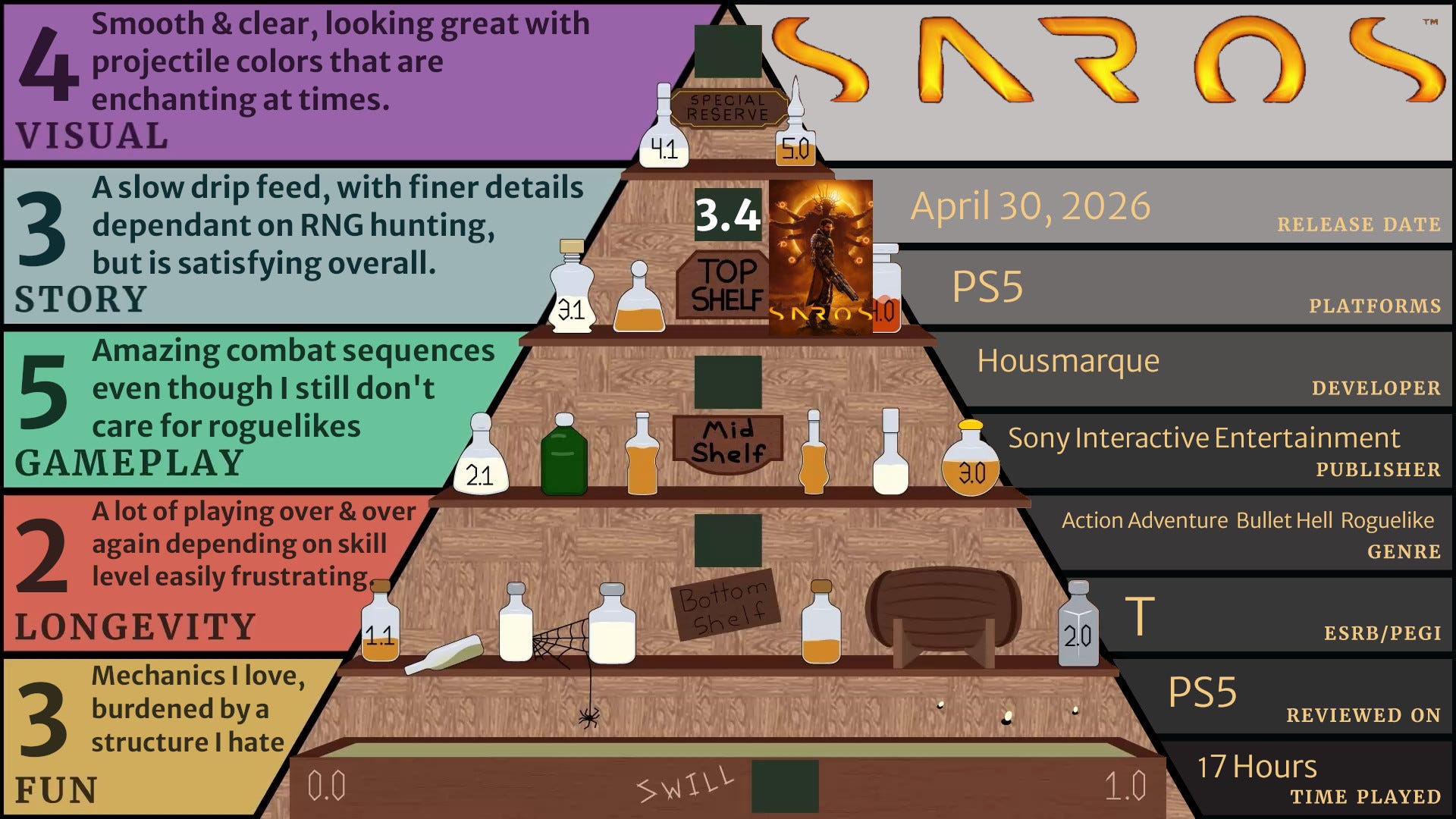
Release: April 30, 2026
Platform: PS5
Developer: Housemarque
Publisher: Sony Interactive Entertainment
Genre: Action, Third-Person Shooter, Roguelike
ESRB: T
Reviewed on: PS5
Time Played: 17 Hours
--- THE ATMOSPHERE OF CARCOSA ---
The shifting alien world of Carcosa feels like it wants to consume you the moment you step foot on it. A dominant golden hue coats the entire environment, illuminating dark, machinery-filled canyons and marshes crawling with malformed, machine-like monsters. In Saros, Housemarque’s new action-adventure roguelike bullet-hell shooter, you play as Arjun Devraj, a Soltari enforcer with a massive hero complex.
Deployed by Soltari on the Echelon IV, your mission is to search for three previous Echelon expeditions that went dark. But what you actually find is a slow build-up of madness and a highly kinetic combat loop that demands absolute perfection. Today, I am breaking down exactly why Saros is a game of incredible highs and frustrating lows, and why I absolutely love its combat mechanics but really hate the grueling structure that forces me through it.
--- THE AVERAGE CYCLE ---
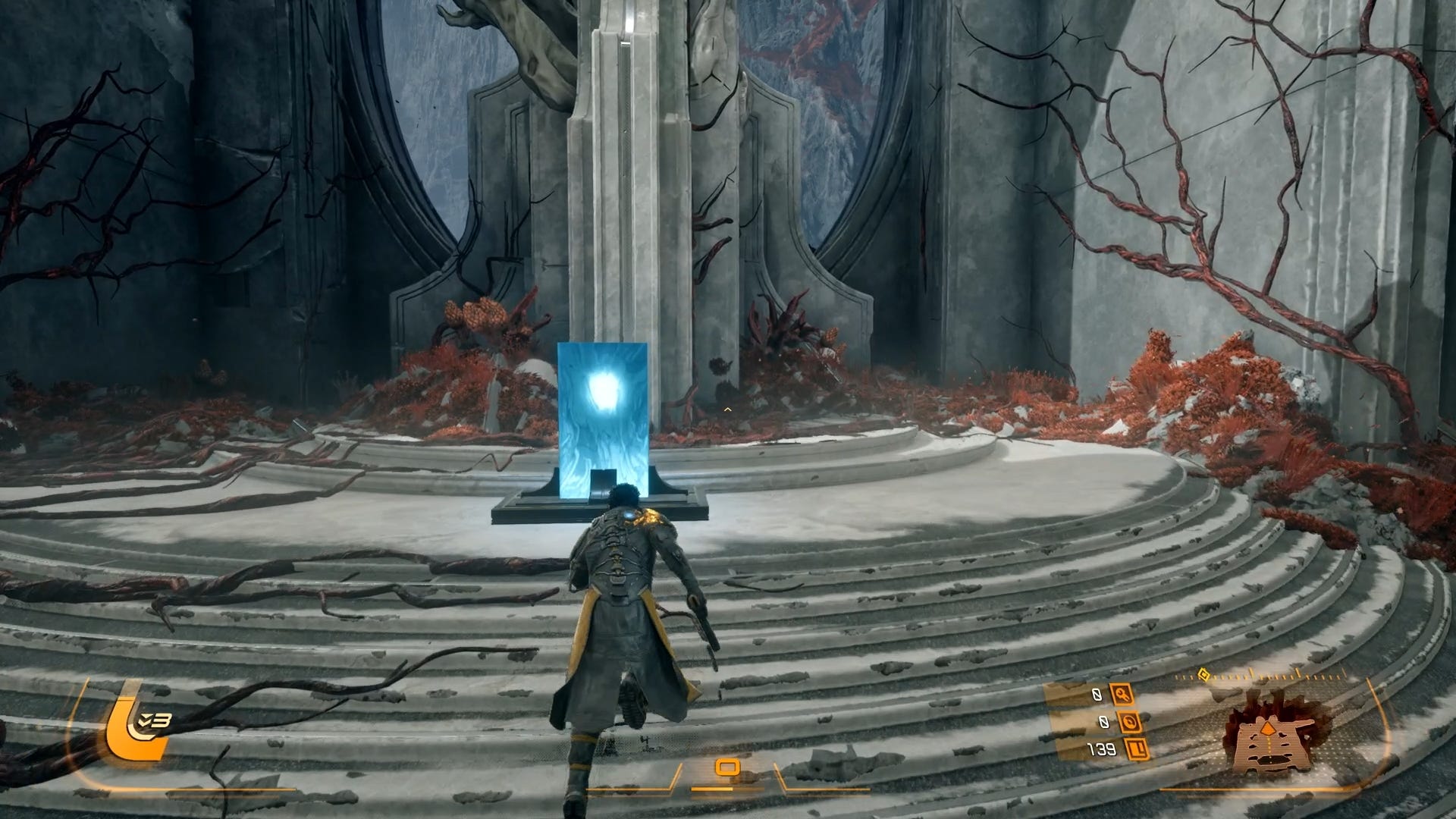
When ready, you will venture forth from your home base into the land of Carcosa, following the footsteps of those who came before you. Your route will be fraught with danger every step of the way, filled with enemies who want to end you simply for being there. Scattered throughout, you will find Holo-Caches, essentially loot boxes, that will provide all you need to survive. Weapons, artifacts, materials, and healing options.
To increase your strength, you will raise three attributes by picking up found artifacts. Resilience, which governs overall health and defense; power, increasing power gun and shield strength, and drive, which determines how much Lucenite you find, the currency needed for upgrades at base and increases your proficiency level during a run. The higher your proficiency, the more capable your guns will be.
Eventually, you will not be able to move forward without activating the Eclipse, which turns the world around you and your enemies more aggressive and capable in fights. Suddenly, yellow projectiles will be brought into play, and any artifacts you find will be corrupt, turning them into a double-edged sword by providing both a benefit and a detriment, making them that much harder to pick up. At the end of every zone will be a tough boss. If you can manage to take them out, you can return home with pride, a bag full of Lucenite, and a portal to the next area. Or you’ll die, ending up back at base full of shame, half your Lucenite lost, and having to start over at your base attribute and proficiency level to try again.
--- A DANCE-LIKE COMBAT LOOP ---
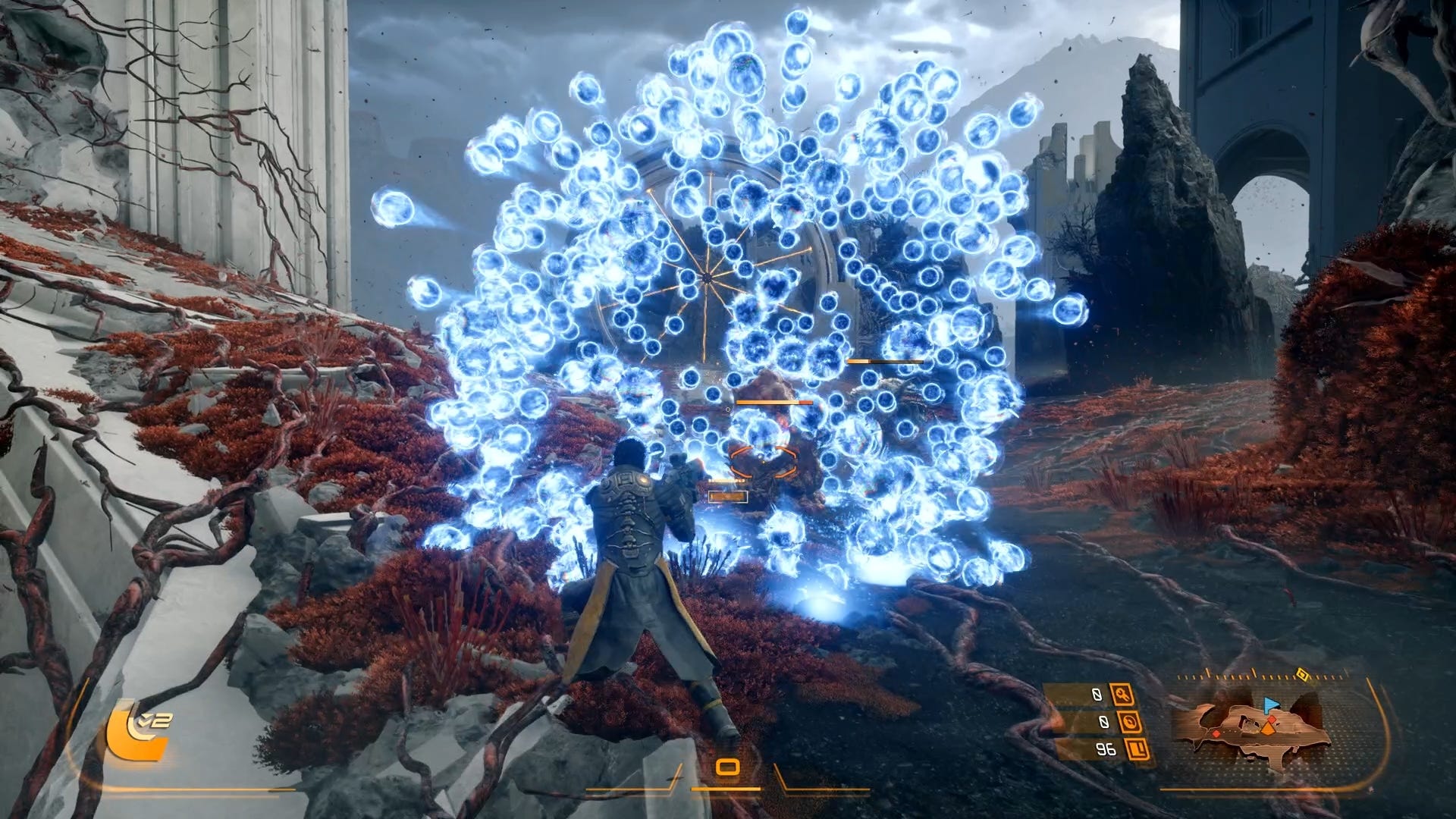
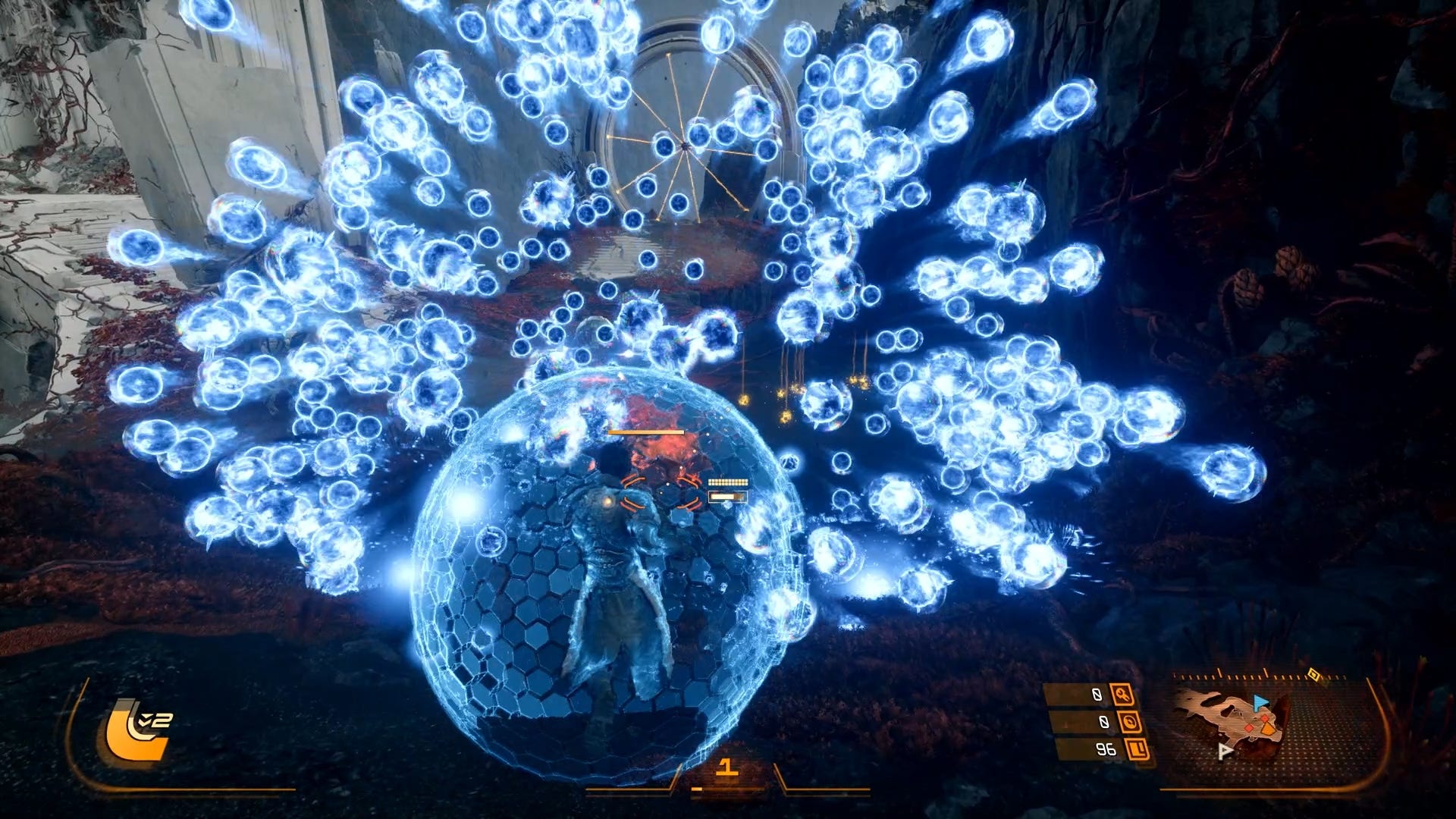
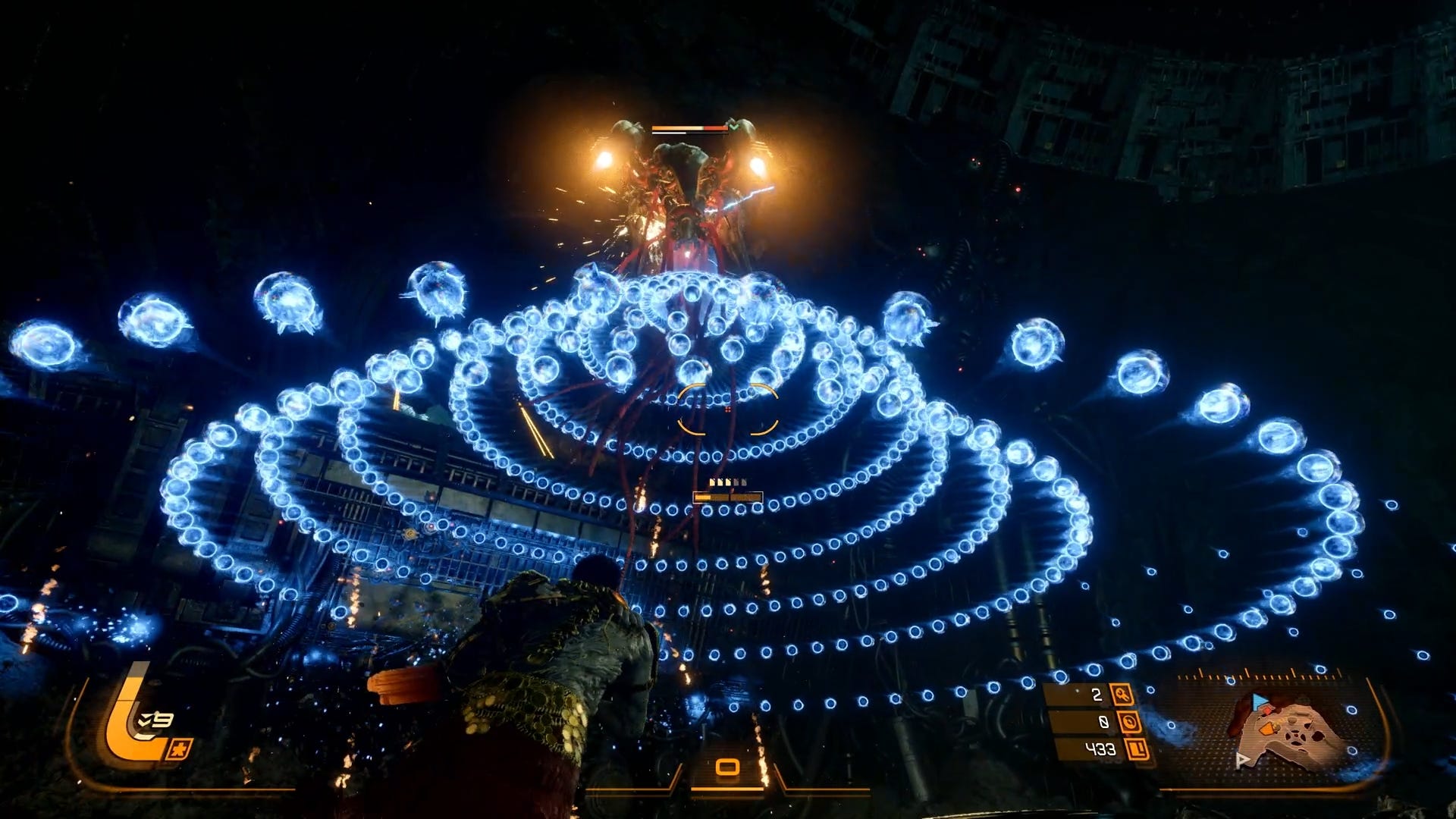
You are constantly engaged in a high-energy back-and-forth dance in a game that relies heavily on color logic to dictate your movements. While all projectiles will hurt if they touch you, each color dictates the proper reaction. You dodge yellow projectiles that cause corruption, lowering your max health, avoid or parry the red ones, and actively hunt down the blue ones to absorb them. Soaking up that blue energy fills your power bar. Once filled, you can unleash devastating shots like giant explosions or constant laser beams.
You manage all of this while using the fantastic haptic feedback of the dual-stage triggers. You pull the left trigger halfway to a physical stop for your alt-fire, and press it fully to unleash your equipped power gun. With five main guns, each with three varieties and an alt-fire, and four arm-mounted power guns, you have a massive arsenal at your disposal. Firing the Smart Rifle, my favorite, and watching its split rounds home in on targets as the screen fills with projectiles is an absolute blast. You feel unstoppable, especially after learning enemies’ special attack patterns, so you know exactly what to do when they try to destroy you.
--- FRUSTRATING ROGUELIKE REPETITION ---
The roguelike repetition can quickly become frustrating, leading to many repeated playthroughs depending on your skill level. Losing long runs during a boss’s learning phase is a major annoyance, and the punishing level design makes it even worse. In chapter two, the game forced me to take two distinct branching cave paths just to unlock the boss room. Unlike the first chapter, unlocking the boss door did not provide a shortcut.
Every single time I died, I had to run those branches again. When I finally reached the boss the first time, I was already hurting pretty badly. It killed me very quickly before I could even learn its patterns or move sets. The only shortcut I eventually unlocked was activating the Eclipse early, which made the entire journey significantly more difficult. Suddenly, every single enemy could fire yellow projectiles and felt more aggressive, turning a simple run back to the boss into a brutal gauntlet. I realize being forced to start over again and again due to death is a roguelike function, but it was much more frustrating in some sections than others.

--- THE ARMORY AND THE CARCOSAN MODIFIER ---
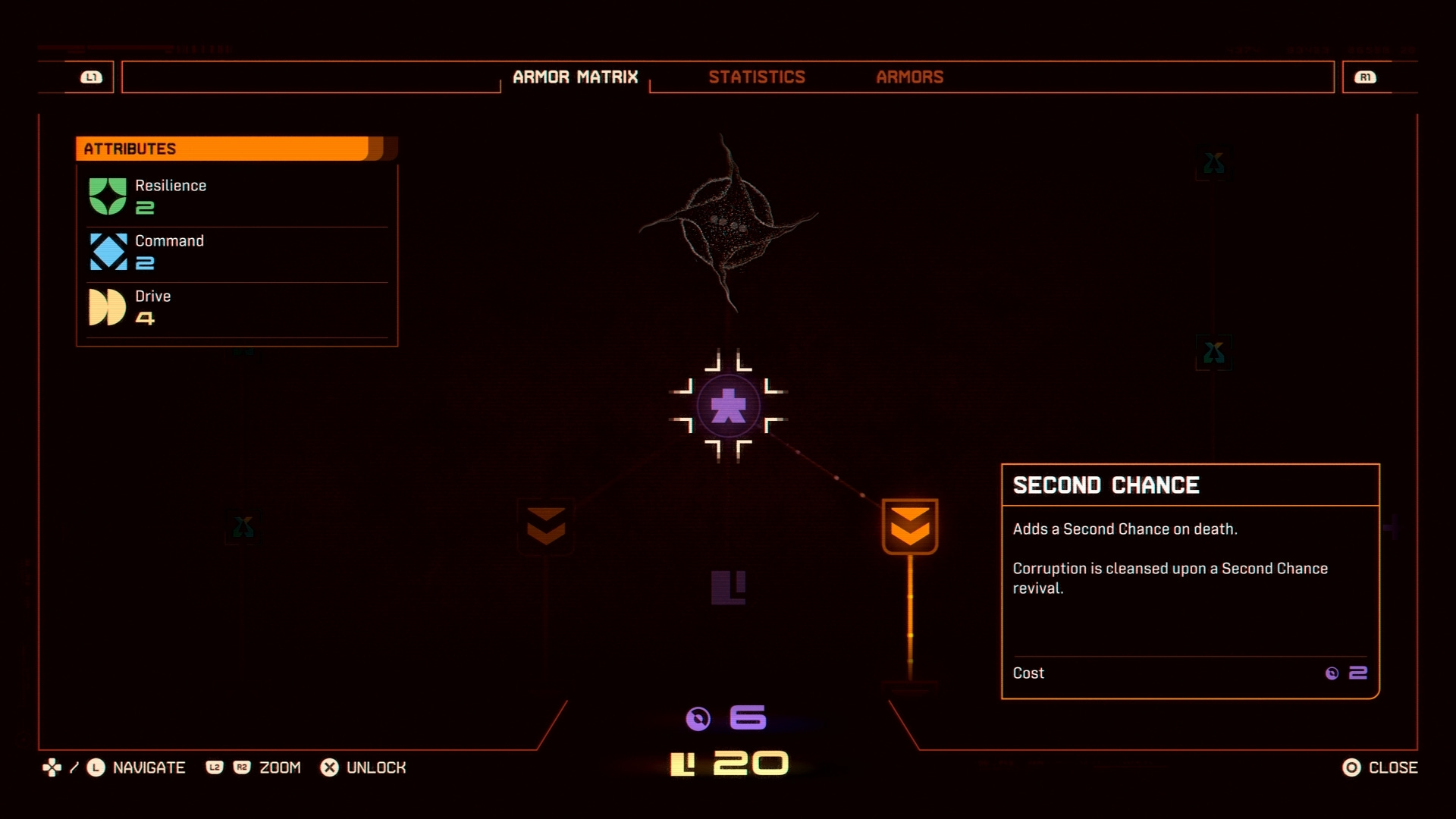
Thankfully you have The Armory, a central hub for permanent character growth so every run doesn’t have to feel like a waste. Here, you spend the Lucenite and Halcyon currencies you gather during your runs, dropped by enemies and found in Holo-Caches. The Armory consists of branching trees moving upwards, unlocking as you open nodes with each section locked behind zone bosses. The upgrades are mostly stat-based, improving attributes like Resilience, Drive, and Power, with a few nodes used to boost your healing effectiveness or extend Lucenite duration on the ground.
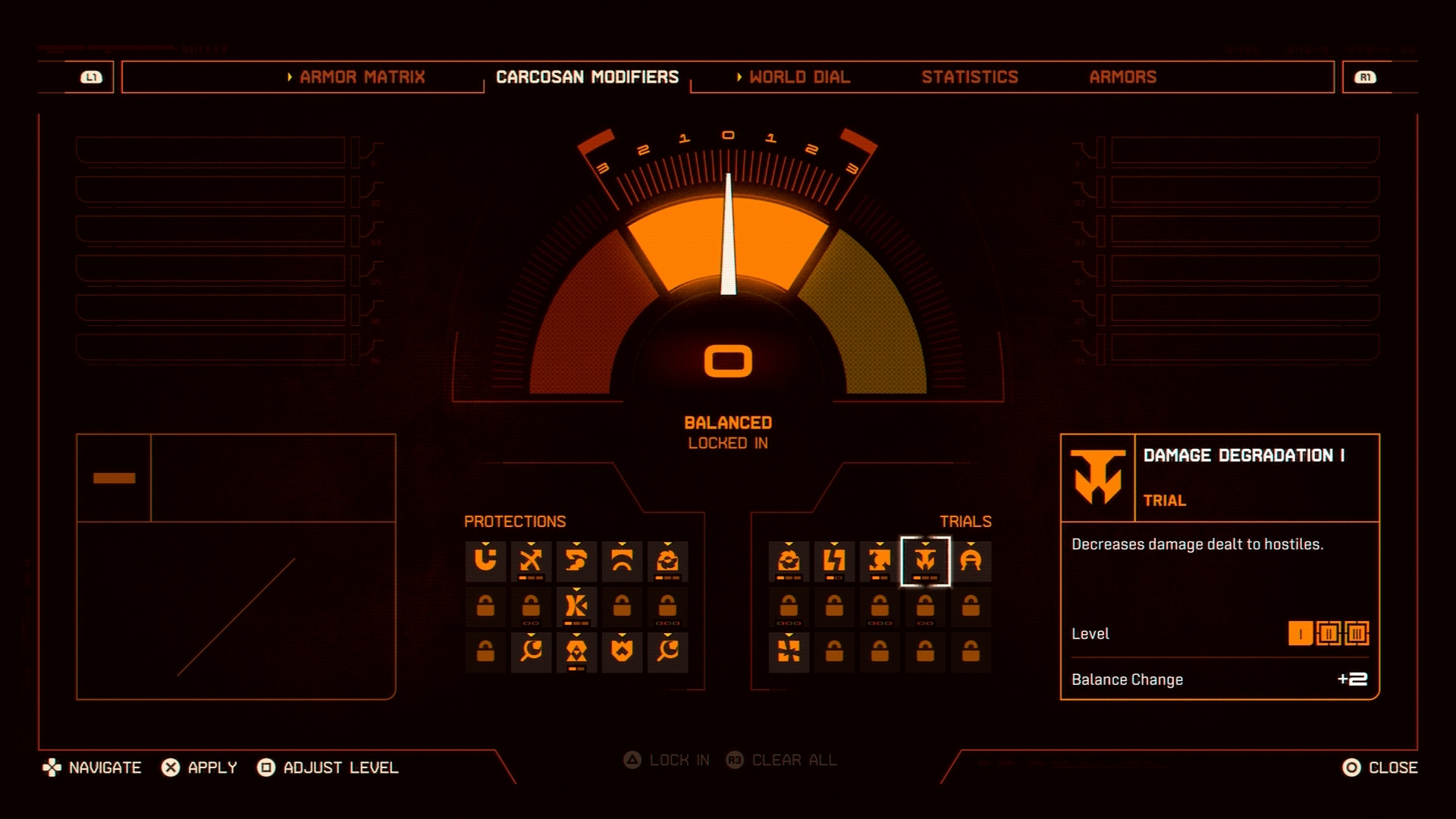
The Carcosan Modifier is a difficulty gauge you can adjust from negative three to positive three. It is a big give and take. You equip helpful mods that push the needle negative, or harmful mods that push it positive, and you have to balance them to keep the needle within that specific window to activate them. I opted for harmful mods that increased my Lucenite loss on death and disabled Halcyon drops, meaning I rarely retained upgrade currency unless I beat the boss. But in exchange, I gained massive defensive and offensive buffs. It completely changed my experience. Instead of dying frequently, I could focus on exploring the dense environments and mastering the combat. I had the defense needed to learn the ins and outs of new enemies without the frustration of restarting consistently. Returning to that first boss with better stats turned the fight into an absolute cake walk.
--- A SLOW DRIP FEED STORY ---
Arjun’s history and the decisions that shaped him are the main draw, revealed through special cutscenes and conversations with his suit. The plot unfolds in a slow drip-feed, relying heavily on RNG hunting to find Databank audio logs, written notes, and conversations with people. Because every area’s layout is random for each run, some areas may have a note or log available, while the same areas may provide a new note on a consecutive run, requiring you to die and/or return frequently until the zone is cleaned out of notes. There is an indicator showing how many different notes are in a zone; if you keep an eye on it, you won’t keep hunting empty areas hoping for a note.
It never felt like a chore to find them, though. They do a fantastic job of building the world and detailing the slow build-up of madness that possessed the previous crews, and what they had gone through before my arrival. It is satisfying overall, even with a few unquestioned details lingering before you hunt for the post-credits true ending.
--- GOLDEN BULLET HELL VISUALS ---
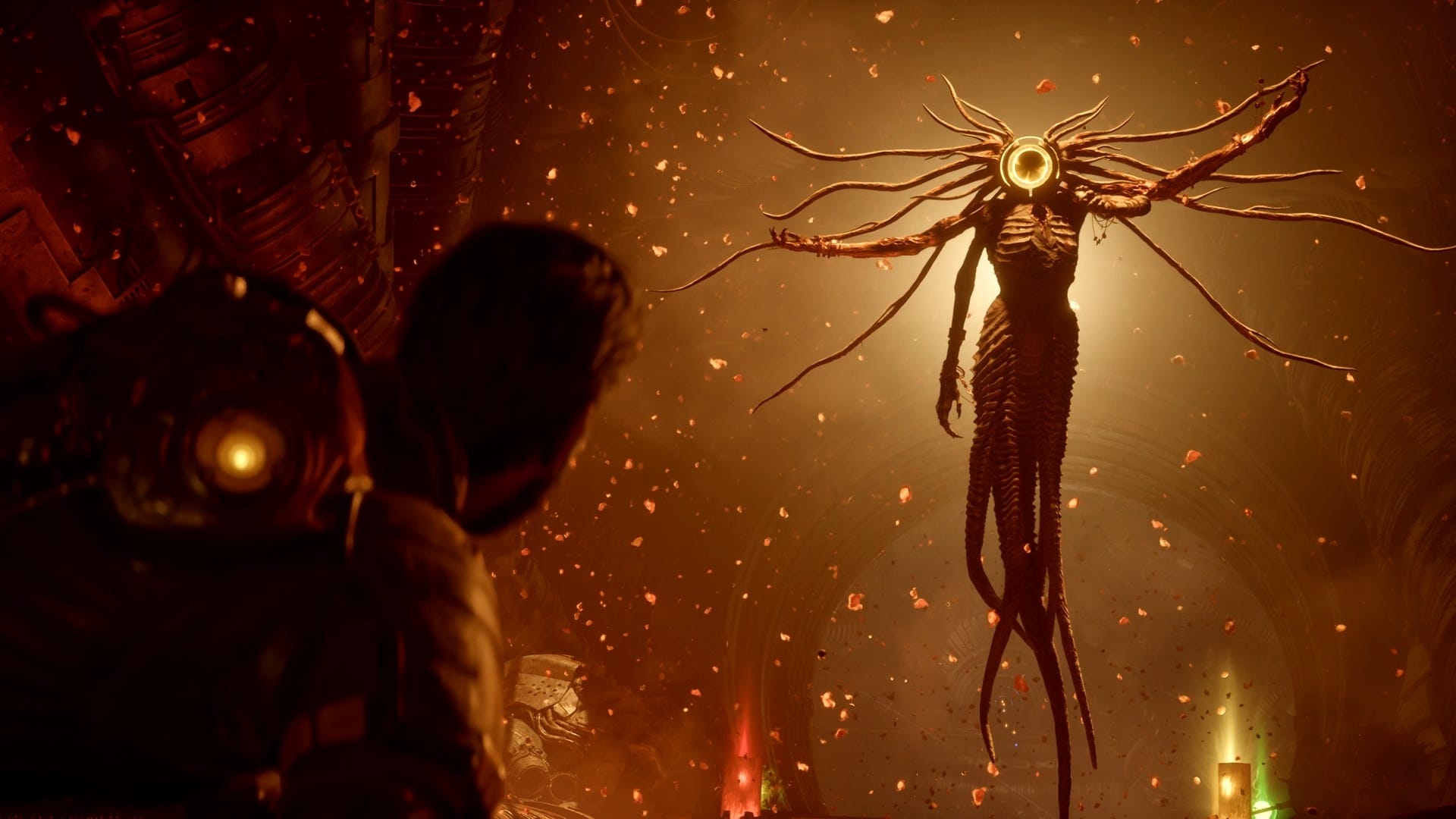
The environments are smooth and clear, featuring high-quality character models across distinct biomes such as canyons, caves, and marshes. A dominant gold aesthetic coats the entire game. Even in dark, machinery-filled rooms lit by red emergency lights, that yellow aesthetic shines through brilliantly. When an Eclipse triggers and every machine-like monster starts firing, the bullet-hell peaks with projectile colors that are enchanting at times.
It looks great, and performance holds up perfectly without any frame drops or loading screens to ruin the flow. I encountered a single glitch where I fell through the floor during a boss fight, but a quick auto-reset fixed it immediately. By the time you reach the final area, the game throws significantly more environmental hazards and dense bullet-hell gauntlets at you, rewarding you with troves of loot, Lucenite, and Holo Caches for surviving. After the credits roll, there is no New Game Plus or daily challenge modes to keep you occupied. Instead, replayability is driven entirely by hunting down remaining Databank entries, cleaning up your trophy list, and testing different weapon loadouts to work toward the true ending path.
--- CAN THE KIDS WATCH? ---
There is light cursing present, though it is mellow. Combat is strictly gun-based, featuring no blood or dismemberment as you fight various machine-like monsters. Thematically, the game deals with a slow build-up of madness, possession, and team members harming each other. Visually, there is some disturbing imagery of statues looking like malformed humans, but there are no sudden jump scares or startling transitions to worry about.
--- RECOMMENDED? ---
If you are a fan of roguelikes, this is a must-buy. If not, you may still enjoy the combat. Learning enemies’ attack patterns and the back-and-forth dance of avoiding danger is incredibly rewarding. This is especially true after the Carcosian Modifier is unlocked, which makes it much easier to bypass the tedious roguelike side of things and focus on the action.