

Watch the review or…
Read it here!
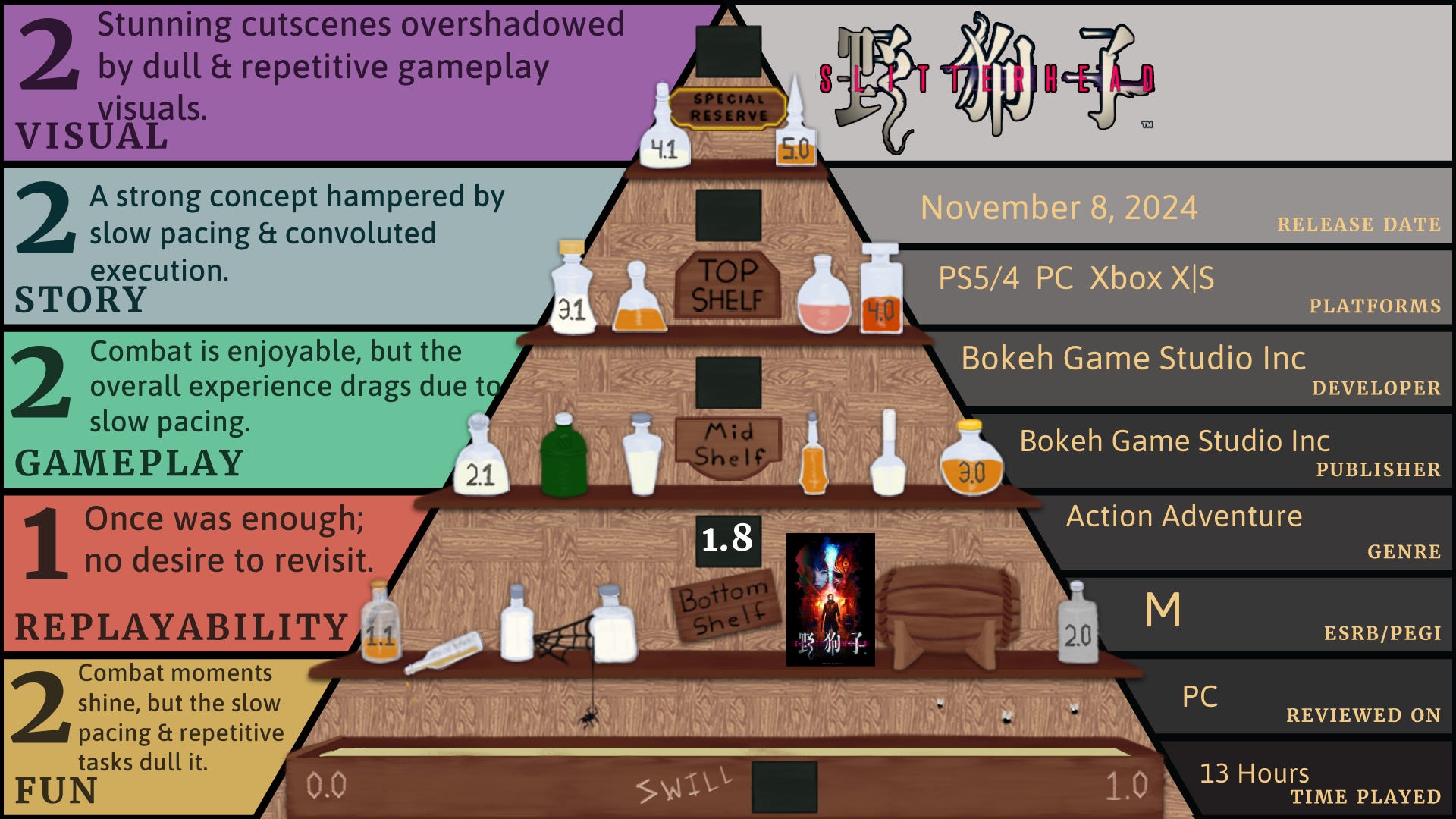
Title: Slitterhead
Release: November 8, 2024
Platform: PS5/4 PC Xbox X|S
Developer: Bokeh Game Studio Inc.
Publisher: Bokeh Game Studio Inc.
Genre: Action Adventure
ESRB: M
Reviewed on: PC
Time Played: 13 Hours
Intro:
A ghostly form, dubbed Night Owl, appears in the dark streets and takes control of a dog’s body. While moving around, Night Owl only knows he has a vision of the city burning with three monsters to blame. He slowly begins to remember his capabilities, like jumping from conscious to conscious and taking control of the attached body. Before long, Night Owl finds a body with a positive reaction to his presence, becoming more robust and agile, ready to fight freaky monsters masquerading as humans. Together, Night Owl and the perfect bodies
This was a very graphic game, with people dying and being torn apart by monsters. Blood was everywhere, and it was even used to create weapons to defend against the Slitterheads. There is also a short scene early on showing some nudity during a very adult act. Given the context of everything involved in the game, it might be best to play after bedtime.
Night Owl is a mysterious being who takes the form of a floating ball of light that can jump from body to body, taking control. While in control of a human’s body, Night Owl can call forth their blood to create weapons. His purpose is unclear; all Night Owl can remember is the need to fight and destroy Slitterheads. Monsters take the form of humans, running the seedy underbelly of the town and murdering people so they could consume their brains.
As you go through the game you will discover rarities, unique people who connected with Night Owl unlike any others. When Night Owl was in control, they gained special abilities and potent fighting weapons. As you complete missions, you will gain skill points to allocate to the strengths of the rarities, like increasing health or weapon damage. Two rarities could be taken on a mission, while on that mission, they would bestow some skills to the regular humans you take over, like poison darts. Some missions required a specific rarity, so you could only choose one, but looking through their skills, some worked well together.
In between missions, you would get the option to talk to the rarities, short conversations teaching you more about them. This was also the only way to unlock new missions, so whether you wanted to learn about them or not, you had to go through the conversations to move the game forward. However, now and again, you would get a choice of response, breaking the monotony of listening to them.
The game’s main enemies were Slitterheads, who came in different shapes and sizes. Small cannon fodder wormlike monsters attempting to overwhelm with their numbers, big bloodworms with legs who tried to take a bite out of you, and the big baddies, who at first would look like a regular human being and be challenging to track down. After being discovered and ready to fight, they came out of their skin, taking on mantis-like, octopus-like, and frogfish-like forms. Boasting giant claws to slice you up with debilitating abilities affecting the battlefield.
A fight would start, whether or not you were in a rarity when you came across the target Slitterhead. You could attack, block, and dodge no matter what body you were using. As well as hop into any other nearby body at a moment’s notice, temporarily slowing down time as you traveled. The rarities you took with you on the mission change what other abilities were added to the regular humans; they also came with their own set of abilities to help against the vicious Slitterheads, like buffing their attack power and throwing a small black hole that would pull people into one spot. Most skills require blood to use, so your health would go down if you attacked with skills. However, you could suck up the nearby blood pools created during the fight. Other skills required soul power, gained when you perfectly block attacks.
While in combat, you may lose all the life from the body you were in. You would automatically get kicked out and find another body when that happened. If you “died” three times, that was game over, starting you over at the nearest auto-save spot. The bodies could be revived if you could find the time between attacks to bring them up, or you could forget about them and keep fighting with whoever was left.
The game was divided into days and missions. Most of the missions involved detective-like work, hunting down Slitterheads by searching the area and finding clues. When the Slitterhead was discovered, sometimes the showdown would happen immediately, and other times, you would have to chase the enemy through the streets and rooftops, hopping from body to body until they finally stopped to fight.
Some mission areas hid more than Slitterheads in the form of Memories, unique fights, rarities, and old lady conversations. After you complete a mission you can view it from the selector and see if there was anything more you could discover. The story would sometimes hit a wall until you found the pertinent rarities needed to move it forward. So they made you go back through a mission to find a different path to unlock them. The memories granted Night Owl conversations and skill points, while the unique fights could reward you with new clothes for the rarities to wear. The old lady conversations were odd, but there was a reward at the end if you could manage to find her enough times.
Final Thoughts
(Segue to Final Thoughts involving a call to action like commenting about game or review)
The cut scenes in Slitterhead were incredible. The monsters’ transformation from human forms brought the game a unique, cool, almost scary look. However, when playing the game, the visuals begin to wane. The possible humans that could be taken over were selected from a small pool of potential looks unless they were essential to the story. Those were the only unique models. The city looked all right, with the differing areas of back alleys to bustling street markets, flashy lights, and billboards everywhere. While on a mission exploring the city, you were confined to the mission area. Blocked off by walls or automatically turned around if you attempt to walk down an empty street to nowhere.
The story began with the fascinating concept of time travel involving something between spirits, aliens, or some other super natural being. But as the game slugged forward, it got more and more convoluted. Between the slow pace and the complicated topics, I was ready for it to be over long before I reached the end. While playing, I had some excellent theories about what to expect to happen and was prepared for some incredible twists to blow my mind, but it never went down that way.
Hopping from body to body was smooth and worked very well. I enjoyed the combat sequences, but that was only about half of the game. The rest was walking around talking to the correct people or finding clues. It was less fast-paced than I was expecting it to be. While the combat was fun, I didn’t feel the characters improved much by upgrading their skills. They felt tough if I went back to early missions, but the last half of the game seemed to consist of tanky enemies requiring more tactical play with the rarity’s skills rather than viciously beating the enemies down with constant attacks. That wouldn’t have been an issue if I was more into the game and didn’t want to finish as quickly as possible.
The idea of Slitterhead was much better than the actuality of playing it. I didn’t have much fun trudging my way through. I think it boils down to how slow the game moved. After four hours of gameplay, I got an achievement that I had only beaten twenty Slitterheads by that time; it’s more of a confusing story than a fast-paced action game. When the game felt like it was gaining momentum, the mission would be over, and I would have to sit and listen to my rarities for a while before a new mission would unlock for me to get out and play again.
The visuals of most of the game were dull & repetitive. However, the cut scenes were terrific; overall, it’s getting a 2
The story had a good concept, but the delivery fell short; I’m giving it a 2
The combat Gameplay was the most enjoyable part of the game; the rest was slow-paced and dull; that’s getting another 2
I don’t imagine I would ever want to replay this game. Once was plenty, I wouldn’t revisit; that’s a 1
I beat the game after thirteen hours and was ready for the end around eight hours in. The fun was there, but short-lived; that’s another 2
Giving Slitterhead an average score of 1.8 out of 5, earning it a spot on the bottom shelf. If you’re interested in some unique gameplay and a bizarre story, this could be a game you’d want to check out, but only when it’s on a very low sale. I’m glad to be done with it; if you want to see more of the game, check out my live stream; it will give you an excellent idea of what you would be getting into