

Title: Styx: Blades of Greed
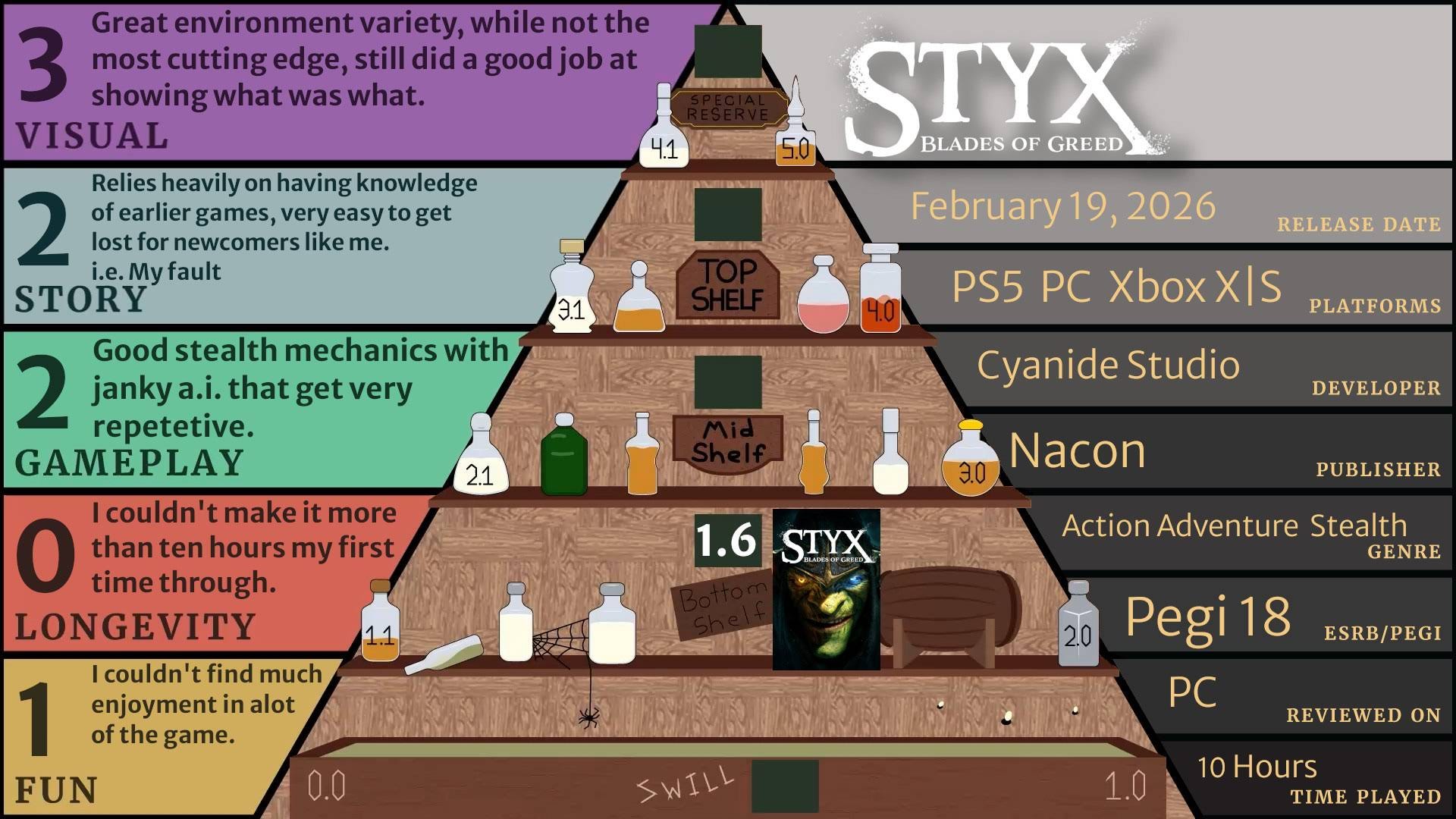
Release: February 19, 2026
Platform: PS5 PC Xbox X|S
Developer: Cyanide Studio
Publisher: Nacon
Genre: Action Adventure
ESRB: PEGI 18
Reviewed on: PC
Time Played: 9 Hours
Styx: Blades of Greed is the third game in a series that has carved out a very specific niche, featuring a protagonist who is as small and stealthy as he is foul-mouthed. It has been nearly ten years since I last slipped into the worn leather boots of this cynical goblin in the second game, an experience that only lasted a few hours for me at the time. As I started this new adventure, I struggled to remember exactly why I hadn't spent more time with the previous installment. However, those reasons quickly came back to me with startling clarity once I began this new journey. While there is certainly a lot to enjoy in this game, a lot of the core mechanics and design choices ultimately failed to hit the mark for me.
The variety of characters and environments is a standout feature of the game. I found myself moving from the dark, grime-coated alleyways of a city to lush green forests full of giant insects and other hidden threats. Each environment required a different strategy for staying hidden. While the graphics might not be the most advanced by today's standards, they are more than enough to convey the scale and mood of the world. However, the technical execution of these visuals sometimes hindered my progress. I struggled in the darker sections because I couldn't find a brightness or gamma setting once the campaign started. This forced me to navigate several areas in complete darkness, groping blindly until I found a light source.
Things were further complicated by inconsistent lighting; often, I could see the entire interior of a room from the hallway, only for the room to suddenly fall into unnatural shadow as I crossed the threshold. In a game where visibility is a key resource, these technical issues felt more like obstacles than deliberate gameplay challenges.
The story of Blades of Greed heavily relies on the player having in-depth knowledge of the previous two games. I appreciate a sequel that respects its fans by avoiding repetitive origin story moments, so it’s my own fault for being lost in the narrative. The story assumes familiarity with the world that a newcomer simply won't have. From what I could tell, Styx is a unique goblin who can absorb "Quartz," a volatile magical mineral that gives him enhanced physical abilities and magical powers. He partners with a crew of “friends" who seem to exist in a state of mutual, begrudging tolerance. While the overarching political plot felt beyond my understanding, the character writing was definitely a highlight. The banter between the crew members is sharp, cynical, and often genuinely funny, adding a much-needed layer of personality to an otherwise dense and sometimes confusing story.
What this series is most known for, however, is its dedication to pure stealth mechanics. Styx starts with a strong set of tools for sneaking and silent takedowns, with more advanced abilities, like clones and invisibility, unlocking as you gather items and upgrade your skill tree. The game is deliberately punishing; while you can engage in a risky sword fight against a guard or two, Styx is extremely fragile. A single missed dodge or mistimed parry nearly always results in a game-over screen. This high-stakes cycle encourages a more creative, goblin-like approach to problem-solving. If a direct route is too dangerous, you can use more treacherous tactics, such as spitting into an enemy’s food or water to poison them from afar. Staying in the rafters and shadows isn't just a playstyle here; it’s essential for survival.
Remaining in stealth felt rewarding as long as I followed a few solid rules: stick to the shadows, stay out of sight, hide the bodies, and keep noise to a minimum. Sound design plays a crucial role here, as even the clink of a falling bottle can alert guards from the next room. If I was spotted, running away was frantic and difficult, depending on how close the enemies were. However, there were moments when the game seemed to break its own rules. On more than one occasion, guards would see me through solid walls while I was standing over a dead body. These instances were rare, but they were incredibly frustrating because they felt like the game was cheating. In a stealth game, the player needs to trust that the mechanics are consistent; when that trust is broken, it makes the high difficulty feel unfair rather than challenging.
While sneaking, Styx isn’t limited to the ground. The levels feature a lot of verticality, with many climbable pipes, ledges, and nooks. My favorite addition was the grappling hook, which doubled the areas I could explore and made me feel like a true predator in the rafters. However, while it was easy to scale a building, descending was often more awkward. Styx can usually drop down and cling to objects, but I found several spots, including one right next to a fast travel hub, where there was no clear way back to the ground. This often forced me to choose between taking a long, tedious detour to find the right path down or jumping and risking fall damage just to save time. It seemed like a strange oversight in a game that otherwise emphasizes fluid movement.
Although I love the stealth genre, I found it hard to fully connect with the structure of this particular series. It often felt like I had too much freedom, pushing the game close to a sandbox experience without the crafting or customization options. I could travel between different hubs, pick up side quests, and hunt for Quartz using a compass, but these tasks never felt urgent. Reaching a Quartz deposit often required complex platforming, yet the reward never quite seemed worth the effort. As someone who is admittedly "geographically challenged," the lack of clear in-game navigation aids meant that I often got lost. Without specific skills to assist with pathfinding, I spent a lot of time wandering in circles.
I played the game for ten hours before deciding it wasn't for me. My last hour was filled with frustration as I tried to figure out how to get past a large bridge full of guards. The goal was to reach a high vantage point, but there were no clear climbing spots or grappling points. I ran around in circles until I finally lost patience and took out every guard on the bridge just to clear my mind. Even then, standing alone among dozens of lifeless bodies, I couldn't find the way forward. By that point, the game wasn't engaging enough to keep me going. It felt like I had seen everything the gameplay had to offer, except for the ending of this chapter of Styx’s story.
Because of that, I’m placing Styx: Blades of Greed on my Bottom-Shelf. If you have been a longtime fan of the series and already understand the lore and the quirks of the game, I imagine you will absolutely love what is offered here. However, if you have never experienced a Styx game before, I would strongly recommend checking out the earlier titles on sale first. This isn't the best place to start your journey with the world's grumpiest goblin.